



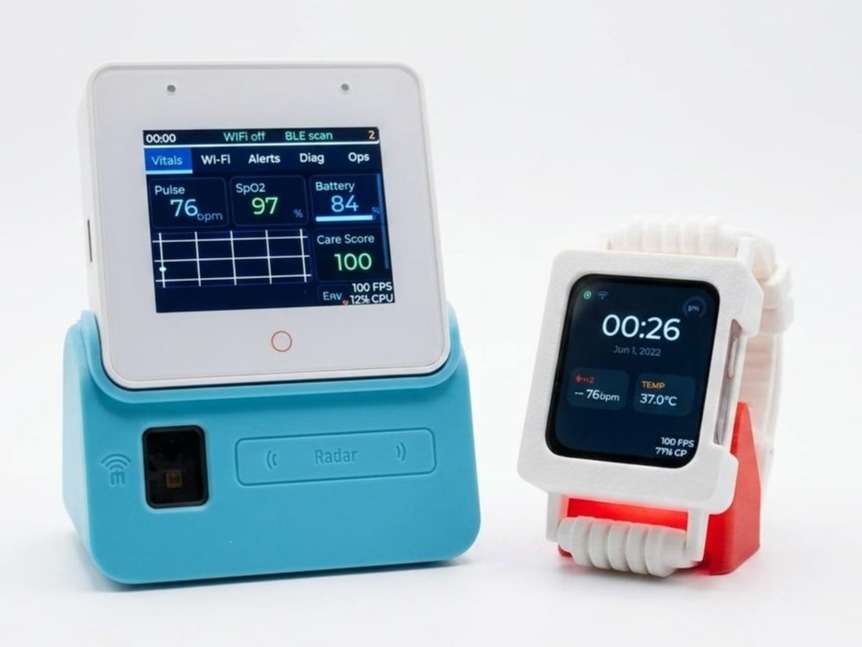
AlzGuard – Intelligent Healthcare and Safety Ecosystem for Alzheimer Patients
Alzheimer’s disease affects millions of elderly individuals worldwide, causing severe memory loss, confusion, disorientation, medication negligence, and increased risk of unattended accidents such as falls. Patients often struggle with remembering medications, monitoring their health conditions, and responding during emergencies. Caregivers and family members also face difficulties in continuously monitoring patients while managing daily responsibilities.
Existing wearable devices mainly focus on fitness tracking and do not specifically address the critical healthcare and safety needs of Alzheimer patients.
To solve this real-world challenge, we developed AlzGuard, an intelligent wearable healthcare and emergency assistance ecosystem specifically designed for Alzheimer patients.
AlzGuard combines:
• Real-time health monitoring
• Emergency fall detection
• Smart medicine reminders
• Caregiver alert system
• Wireless BLE and Wi-Fi connectivity
• Companion monitoring device
• Custom-designed wearable hardware
Unlike traditional smartwatch prototypes, AlzGuard was designed as a complete assistive healthcare system focusing on practical real-world usability, patient safety, and caregiver interaction.
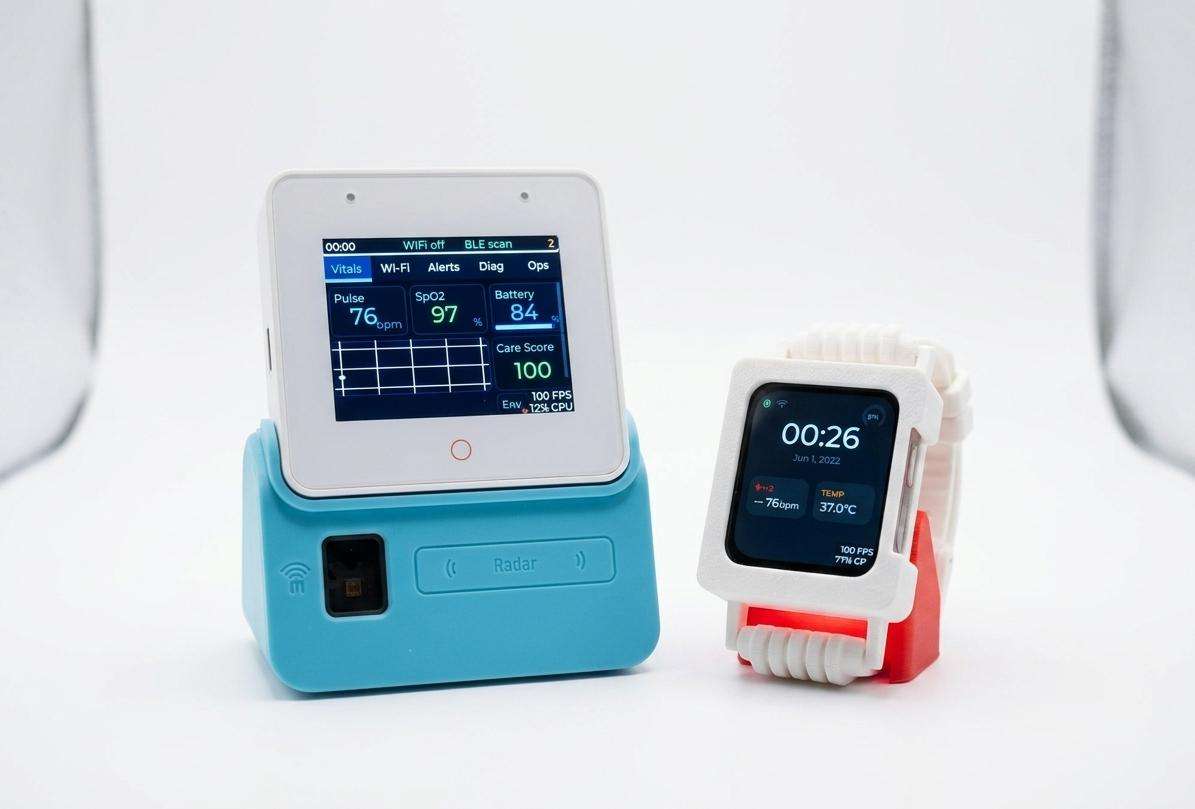
Project Objectives
The primary objectives of AlzGuard are:
• Improve patient safety during unattended situations
• Reduce medication negligence through smart reminders
• Enable real-time health monitoring
• Assist caregivers through continuous monitoring
• Detect emergency fall incidents automatically
• Create a comfortable and practical wearable solution
• Provide reliable wireless communication for healthcare monitoring
System Architecture
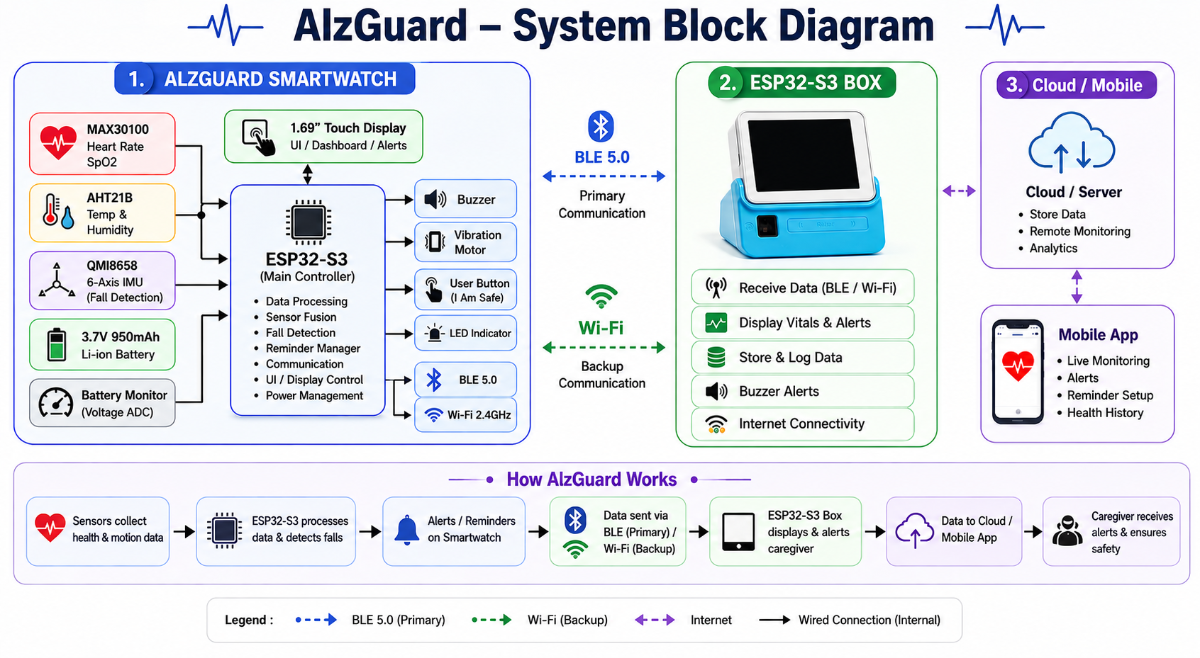
The AlzGuard ecosystem consists of two major subsystems:
1. Smartwatch Unit
A wearable health monitoring smartwatch used directly by the Alzheimer patient.
Main Functions:
• Heart rate monitoring
• Blood oxygen monitoring (SpO2)
• Temperature monitoring
• Humidity monitoring
• Fall detection
• Smart reminders
• Touchscreen interaction
• BLE communication
• Wi-Fi connectivity
• Emergency alerts
2. Caregiver Companion Device
An ESP32-S3 based monitoring companion used by caregivers or family members.
Main Functions:
• Live health monitoring
• Emergency alert notifications
• Reminder notifications
• Connectivity monitoring
• Real-time patient status dashboard
Hardware Components Used
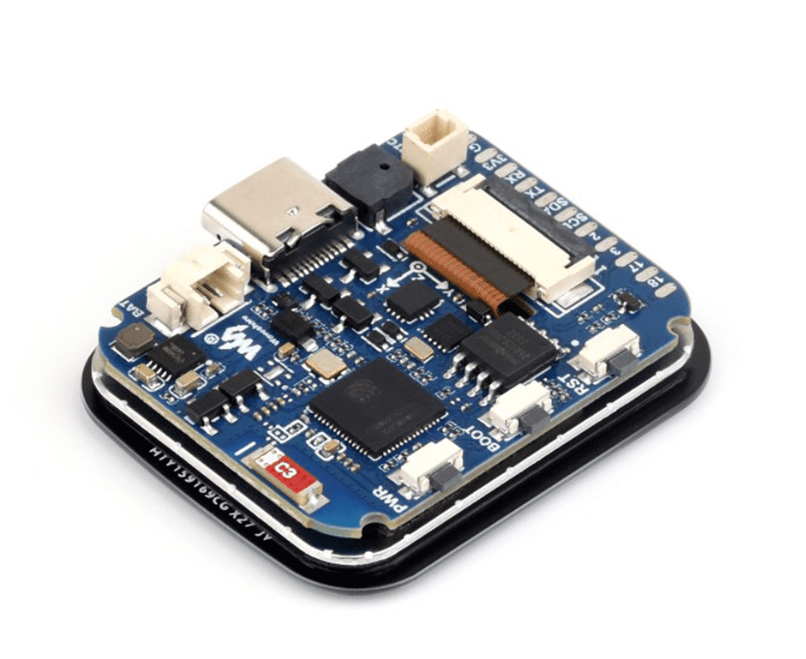
1. Waveshare ESP32-S3 1.69-inch Touch Display Development Board
The Waveshare ESP32-S3 touch display board acts as the main controller of the smartwatch system.
Features:
• ESP32-S3 dual-core processor
• 1.69-inch capacitive touchscreen
• Integrated Wi-Fi
• Bluetooth Low Energy support
• Built-in IMU sensor
• Compact wearable-friendly design
The board handles:
• Sensor processing
• Display management
• Touch interaction
• Wireless communication
• Fall detection processing
• User interface rendering
2. MAX30100 Pulse Oximeter and Heart Rate Sensor
The MAX30100 sensor is used for real-time healthcare monitoring.
Functions:
• Heart rate monitoring
• Blood oxygen level monitoring (SpO2)
This allows continuous observation of patient health conditions.
.png)
3. AHT21B Temperature and Humidity Sensor
The AHT21B sensor monitors environmental conditions surrounding the patient.
Functions:
• Temperature sensing
• Humidity sensing
This helps provide additional healthcare context for caregivers.
.png)
4. 3.7V 950mAh Rechargeable Battery
The smartwatch is powered using a compact lithium-ion rechargeable battery.
Advantages:
• Portable operation
• Lightweight design
• Long-duration monitoring
• Rechargeable functionality
Battery optimization was carefully considered to maintain compact wearable usability.
.png)
5. ESP32-S3-BOX-3 Companion Device
The ESP32-S3-BOX-3 acts as the caregiver monitoring companion.
Functions:
• Receives emergency alerts
• Displays patient vitals
• Monitors reminders
• Provides continuous monitoring
This creates a dedicated healthcare monitoring station for caregivers.
.png)
Wiring Table
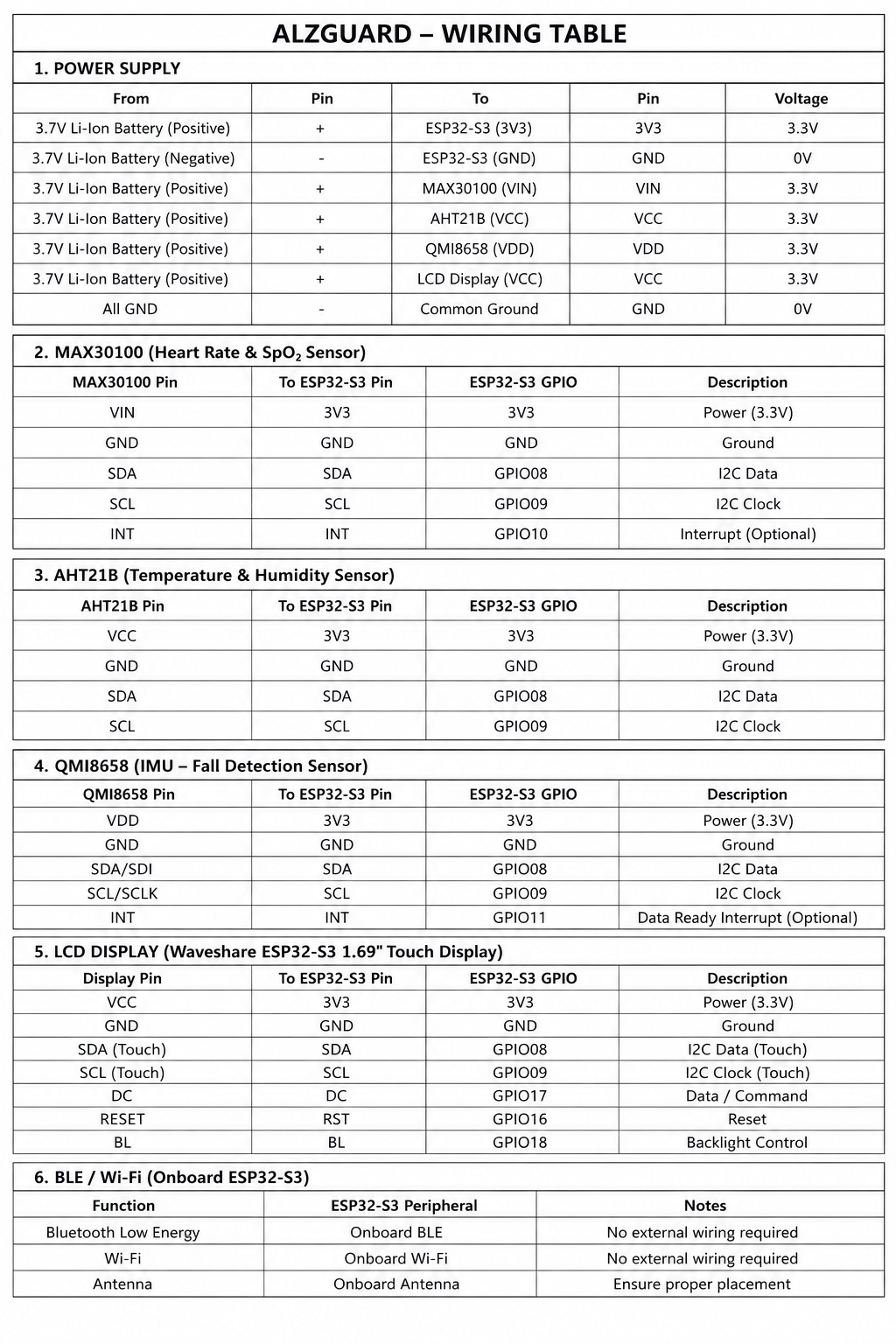
Note : This pin diagram is for the Waveshare 1.69-inch LCD. If you are using the display with an ESP32-S3 Development Kit, the IMU and LCD display wiring can be skipped, as they are already integrated into the development board itself
Custom Smartwatch Design and Fabrication
One of the major engineering challenges was converting the electronics into a practical wearable healthcare device.
Instead of using pre-built enclosures, the smartwatch body was completely custom-designed from scratch.
The following components were fully designed using CAD software (Fusion 360) :
• Smartwatch frame
• Strap mounting system
• Battery compartment
• Sensor housing
• Internal wiring space
• Touchscreen alignment structure
The smartwatch body and strap were manufactured using 3D printing.
Special attention was given to:
• Wearability
• Lightweight construction
• Sensor accessibility
• User comfort
The final design achieved a clean and modern wearable appearance while maintaining functionality and compactness.
.png)
.png)
Hardware Integration
After enclosure fabrication, all hardware modules were integrated carefully inside the smartwatch body.
Integration Process:
• Display alignment and mounting
• Sensor positioning optimization
• Battery placement
• Internal wiring management
• Structural reinforcement
• Touchscreen accessibility testing
The MAX30100 sensor was positioned carefully for better skin contact and improved measurement accuracy.
The battery and sensor layout were optimized to maintain comfort during wearable usage.
.png)
Software Architecture and Firmware Design of AlzGuard
The AlzGuard smartwatch was developed using a modular firmware architecture to ensure:
• Reliability
• Real-time processing
• Low power operation
• Easy scalability
• Efficient wireless communication
• Smooth user interaction
Unlike basic prototype systems, the firmware was designed as a structured healthcare-oriented embedded ecosystem with dedicated modules for:
• Vital monitoring
• Emergency fall detection
• Reminder management
• Battery monitoring
• BLE communication
• Wi-Fi communication
• UI rendering
• Sensor fusion and state management
The firmware was developed on the ESP32-S3 platform using Arduino framework and LVGL graphical library.
Core Device State Architecture
The smartwatch continuously maintains a centralized real-time device state structure.
This structure stores:
• Heart rate
• SpO2
• Temperature
• Humidity
• Battery percentage
• Accelerometer values
• Gyroscope values
• Connectivity status
• Fall detection status
• Real-time clock information
Device State Structure
struct DeviceState {
    float heartRate    = 0;
    float spo2         = 0;
    float temperature  = 0;
    float humidity     = 0;
    float batteryPct   = 0;

    float accelX = 0, accelY = 0, accelZ = 0;
    float gyroX  = 0, gyroY  = 0, gyroZ  = 0;

    bool  fallDetected = false;

    bool bleConnected  = false;
    bool wifiConnected = false;
};
This centralized architecture allows all modules to access synchronized health and motion data efficiently.
Vital Monitoring System
The smartwatch continuously monitors patient vitals using dedicated healthcare sensors.
Heart Rate and SpO2 Monitoring
The MAX30100 sensor was integrated for:
• Heart rate monitoring
• Blood oxygen level measurement
The ESP32-S3 continuously acquires data from the sensor and updates the UI dashboard in real time.
Features
• Continuous health monitoring
• Real-time dashboard updates
• Live caregiver monitoring
• Wireless health data transmission
Environmental Monitoring System
The AHT21B sensor continuously measures:
• Temperature
• Humidity
These environmental values are displayed on both:
• Smartwatch interface
• Caregiver dashboard
This helps caregivers understand the surrounding environmental conditions of the patient.
Intelligent Fall Detection System
One of the most advanced modules in AlzGuard is the intelligent multi-stage fall detection engine.
Unlike simple threshold-based systems, AlzGuard uses:
• Free-fall analysis
• Impact detection
• Motion stillness confirmation
• Orientation analysis
to significantly reduce false positives.
Multi-Stage Fall Detection Algorithm
Phase 1 – Free Fall Detection
The system first checks whether acceleration drops below a safe threshold.
static constexpr float FREE_FALL_THRESHOLD = 0.45f;
If acceleration remains below this threshold for a short duration, the system assumes the patient may have lost balance.
Phase 2 – Impact Detection
After free-fall detection, the firmware waits for sudden impact acceleration.
static constexpr float IMPACT_THRESHOLD = 2.4f;
This indicates possible collision with the ground.
Phase 3 – Post-Impact Stillness Analysis
After impact, the firmware checks:
• Whether the patient remains still
• Whether the device orientation changes
• Whether vigorous movement resumes
bool isStill = (mag >= STILL_THRESHOLD_MIN &&
                mag <= STILL_THRESHOLD_MAX)
               && (gyrMag < 50.0f);
This greatly reduces false alarms caused by:
• Running
• Fast hand movement
• Sudden sitting
• Accidental shaking
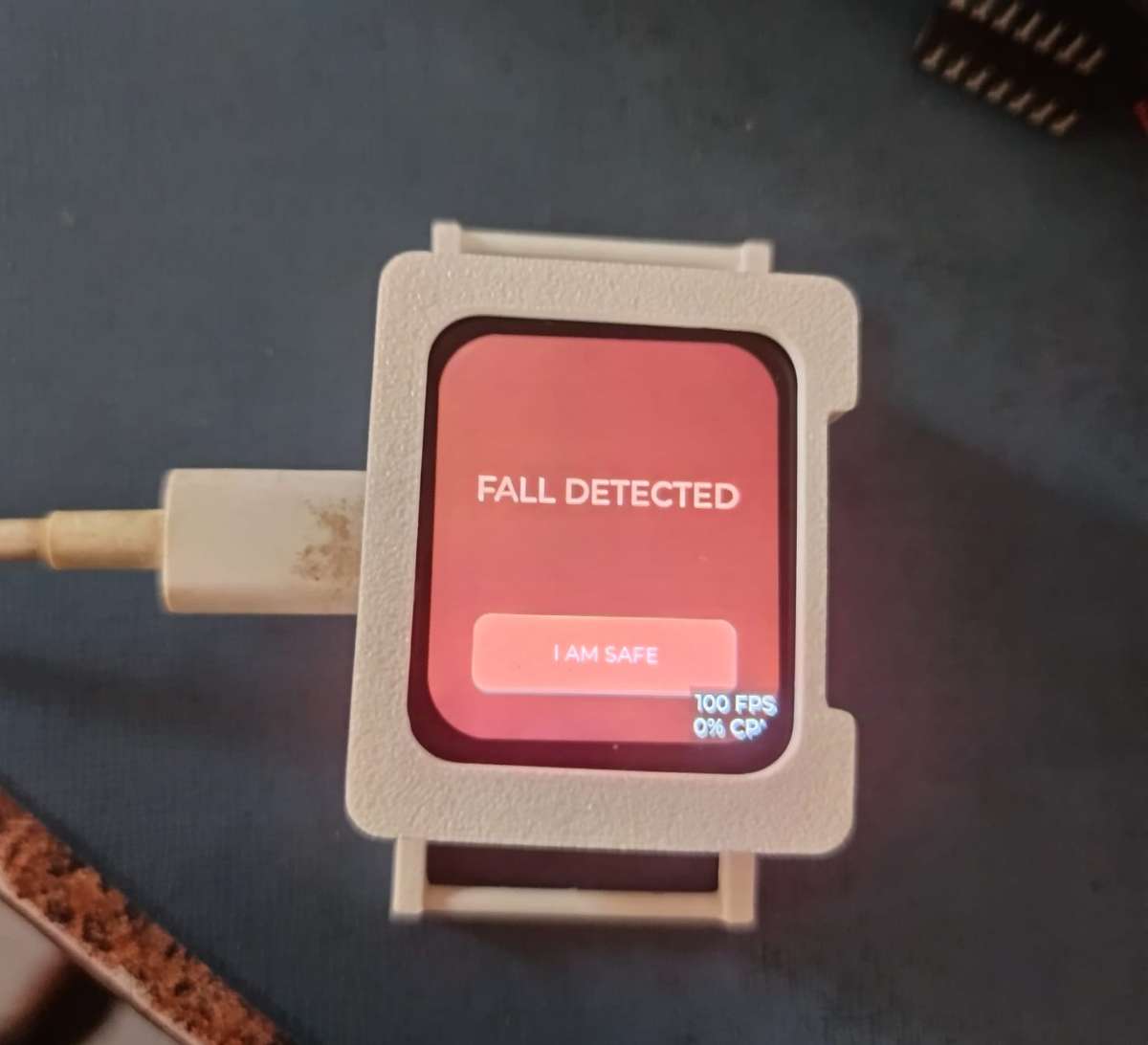
Emergency Safety Interface
When a fall is confirmed:
- Emergency screen appears
- Buzzer activates
- Alert is sent to caregiver device
- User receives “I AM SAFE” option
Fall Alert Interface
lv_label_set_text(lbl_title, "FALL DETECTED");
lv_label_set_text(btn_lbl, "I AM SAFE");
This ensures emergency alerts are only transmitted if the patient truly requires assistance.
Smart Reminder Management System
Alzheimer patients frequently forget:
• Medicines
• Meals
• Water intake
• Daily routines
To solve this, AlzGuard includes a dedicated reminder management engine.
Reminder Types
enum class ReminderType : uint8_t {
    MEDICINE = 0,
    WATER    = 1,
    EXERCISE = 2,
    MEAL     = 3,
    SLEEP    = 4,
    CUSTOM   = 5
};
The firmware supports multiple healthcare-oriented reminder categories.
Reminder Storage System
The reminders are permanently stored using non-volatile storage (NVS).
_prefs->putString("reminders", s);
This ensures reminders remain saved even after device restart or power loss.
Reminder Trigger Engine
When reminder time matches system time:
if (r.hour == hour && r.minute == minute)
the system automatically:
• Wakes the screen
• Activates buzzer
• Displays notification
• Sends BLE alert
• Sends Wi-Fi alert
Reminder Notification Interface
lv_label_set_text(btn_lbl, "GOT IT");
The reminder UI was specifically designed with:
• Large text
• Simple acknowledgment
• Elderly-friendly interaction
.png)
Battery Monitoring and Power Architecture
Portable healthcare devices require reliable battery monitoring for safe operation.
AlzGuard includes a dedicated battery monitoring subsystem using ADC-based voltage sensing.
Battery Voltage Measurement
_voltage = (adcAvg / 4095.0f) * 3.3f * 3.0f;
The firmware continuously converts ADC readings into real battery voltage values.
Battery Percentage Estimation
A lookup-table-based algorithm was implemented for more accurate Li-ion battery estimation.
static const float VOLT_TABLE[] = {
3.00f, 3.50f, 3.60f, 3.70f,
3.75f, 3.80f, 3.90f,
4.00f, 4.10f, 4.20f
};
This improves battery percentage reliability during wearable operation.
Low Battery Warning System
bool isLow() {
    return _percentage < 15.0f;
}
Low battery alerts are automatically displayed on the smartwatch interface.
.png)
Smartwatch User Interface Design
The smartwatch graphical interface was developed using LVGL.
The UI includes:
• Watchface
• Vitals dashboard
• Reminder dashboard
• Device status screen
• Emergency alerts
• Connectivity indicators
The interface uses:
• Large fonts
• Color-coded cards
• Rounded UI elements
• Minimal clutter
• Elderly-friendly design
UI Color Architecture
#define COL_BG lv_color_hex(0x0A0E1A)
#define COL_ACCENT lv_color_hex(0x00E5C8)
#define COL_ALERT lv_color_hex(0xFF5252)
A modern healthcare-inspired color palette was developed for better readability and emergency visibility.
Live Vitals Dashboard
The vitals screen displays:
• Heart rate
• SpO2
• Temperature
• Humidity
• Battery level
using animated arcs and real-time UI updates.
lv_arc_set_value(arc_hr, value);
.png)
BLE Communication Architecture
Bluetooth Low Energy (BLE) was implemented as the primary communication method.
BLE allows:
• Mobile connectivity
• Reminder synchronization
• Live vitals monitoring
• Low-power operation
The smartwatch can connect directly with:
• Smartphones
• Companion ESP32-S3 Box
.png)
Wi-Fi Communication Architecture
Wi-Fi acts as:
• Backup communication layer
• Internet connectivity layer
• Remote alert transmission system
Wi-Fi Connection System
WiFi.begin(ssid.c_str(), pass.c_str());
The smartwatch can connect to:
• Home Wi-Fi
• Mobile hotspot
• Caregiver network
Emergency Alert Transmission
When emergencies occur:
doc["type"] = "fall";
the smartwatch automatically sends:
• Alert type
• Device status
• Battery level
• Heart rate
to connected monitoring systems.
.png)
Caregiver Companion Device
The ESP32-S3-BOX-3 acts as:
• Caregiver dashboard
• Alert receiver
• Monitoring bridge
• Notification display
The caregiver can continuously monitor:
• Patient vitals
• Alerts
• Reminder notifications
• Device connectivity
This improves:
• Emergency response speed
• Caregiver awareness
• Continuous supervision
Power Optimization Features
Several optimizations were implemented to improve battery efficiency:
• BLE low-energy communication
• Efficient UI rendering
• ADC averaging
• Modular processing
• Event-based notifications
This improves portable wearable operation reliability.
Final Software Features of AlzGuard
Healthcare Features
• Heart rate monitoring
• SpO2 monitoring
• Temperature sensing
• Humidity sensing
Emergency Features
• Intelligent fall detection
• Emergency caregiver alerts
• “I AM SAFE” confirmation system
Reminder Features
• Medicine reminders
• Water reminders
• Meal reminders
• Sleep reminders
Connectivity Features
• BLE communication
• Wi-Fi communication
• Companion dashboard
• Mobile integration
Engineering Features
• Modular firmware architecture
• Real-time processing
• Touchscreen graphical UI
• Battery management system
• Non-volatile reminder storage
Conclusion
The AlzGuard software architecture was designed not only as a smartwatch firmware, but as a complete healthcare-oriented embedded ecosystem.
By combining:
• Intelligent sensor processing
• Real-time monitoring
• Emergency response
• Wireless caregiver communication
• Elderly-friendly UI design
• Reliable power management
AlzGuard demonstrates how embedded systems and IoT technologies can be used to improve healthcare accessibility and patient safety in real-world assistive medical applications.
Demonstration Video
full demo :
Github Repository :
Refer for code : https://github.com/Sparkshiva007/AlzGuard-Smartwatch


