




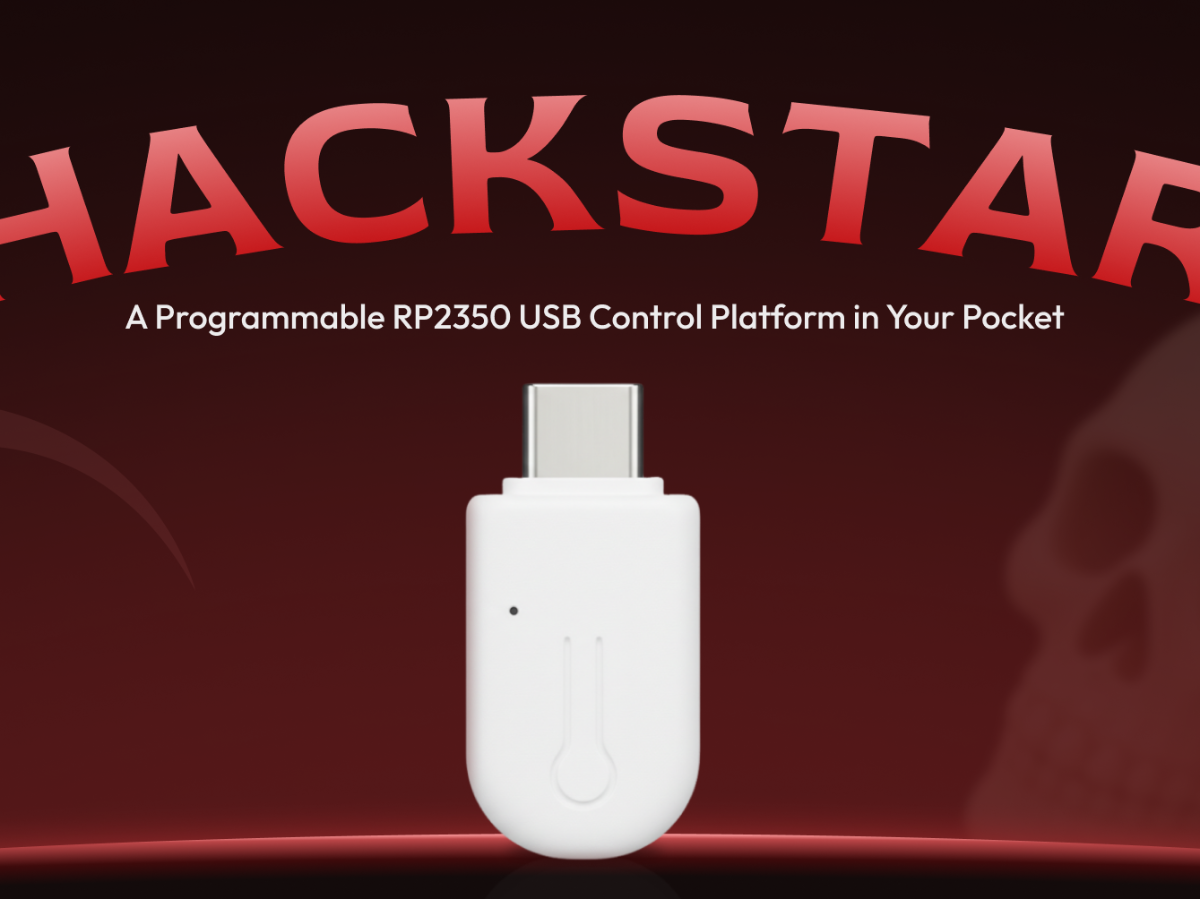


Project Link - https://www.kickstarter.com/projects/arushi/hackstar

🎯 STRETCH GOAL — £15,000
── WHITE ENCLOSURE CASING ──
Help us reach £15,000 and every single backer will receive a custom white enclosure casing — completely free. No extra cost. No add-ons. Just our thank you for pushing HackStar further.
We're working hard to make this happen. The closer we get, the closer you are to receiving your free casing.
Spread the word. Let's unlock this together.

Keystroke Injection
Hardware-Level USB Input Execution
HackStar supports programmable keystroke injection by operating as a standard USB Human Interface Device (HID). When plugged into a system, it is recognized as a keyboard, allowing it to execute pre-defined keystrokes directly at the hardware level. Because this happens through native USB protocols, no additional drivers or software installations are required.

Unlike traditional macro software that depends on the operating system, HackStar performs input automation at the USB layer itself. This makes execution faster, more reliable, and independent of background applications. Developers can define sequences, delays, logic conditions, and multi-step workflows using MicroPython, CircuitPython, or C/C++.
This makes HackStar ideal for automation workflows, productivity scripting, USB HID demonstrations, and controlled ethical security testing.
Cross-Platform Compatible
Works Seamlessly Across Major Operating Systems
HackStar is designed for true cross-platform USB compatibility. Because it follows standard USB HID protocols, it works natively with major operating systems including Windows, macOS, Linux, and Android.
- There is no OS lock-in.
- There are no custom drivers.
- There is no dependency on vendor software.
If a system supports USB keyboards or HID devices, it supports HackStar. This universal compatibility ensures consistent behavior across devices, making it suitable for developers, educators, IT professionals, and automation enthusiasts working in multi-OS environments.
Open Source
HackStar embraces an open-source hardware and firmware philosophy. The codebase, examples, and development tools are accessible, allowing users to inspect, modify, and build upon the platform without restrictions.
Open source means:
- No hidden firmware behavior
- No locked ecosystems
- No proprietary limitations
Developers maintain full control over how HackStar operates. Combined with compatibility within the Raspberry Pi ecosystem, this openness ensures that HackStar remains flexible, adaptable, and future-ready.
It’s not just a device you use — it’s a platform you can truly understand and shape.

Based on Raspberry Pi 2350
HackStar is built around the powerful Raspberry Pi 2350 microcontroller, a next-generation chip designed for modern embedded systems, USB applications, and secure automation platforms. By choosing Raspberry Pi 2350 as its foundation, HackStar delivers serious performance in a compact, plug-and-go device.
HackStar can handle multi-step workflows, timing-sensitive tasks, and advanced programmable behavior without requiring external memory or add-ons.
The Raspberry Pi 2350 also includes native USB support, allowing HackStar to operate efficiently as a USB device and interact seamlessly with host systems. This deep USB integration ensures stable HID execution, reliable cross-platform compatibility, and low-latency performance for automation tasks.
Because HackStar is part of the broader Raspberry Pi ecosystem, developers benefit from established SDKs, community libraries, and familiar development workflows. Whether you prefer MicroPython, CircuitPython, or C/C++, you can build using tools you already know. This lowers the learning curve while preserving advanced customization for experienced developers.
In addition, the Raspberry Pi 2350 introduces modern security features such as TrustZone support and hardware cryptographic acceleration, enabling more secure firmware design and controlled execution environments. This makes HackStar not just powerful and flexible, but also future-ready for evolving automation and security applications.
By building HackStar on Raspberry Pi 2350, we ensured it would be more than a simple USB gadget. It is a capable microcontroller platform designed for performance, adaptability, and long-term developer support.

🚀 RP2350 Dual-Core Performance
HackStar is powered by the Raspberry Pi 2350 dual-core microcontroller. This provides the processing headroom required for USB HID operations, automation scripts, and real-time programmable workflows — all within a compact form factor.
⌨️ Keyboard Injection
HackStar can function as a programmable USB HID keyboard, allowing it to execute predefined keystrokes directly at the hardware level. Because it operates as a standard USB device, it works natively across major operating systems without drivers or additional software.
🧠 Fully Programmable
HackStar gives you complete control over its behavior. You can program it using MicroPython, CircuitPython, or C/C++, defining custom logic, timing, sequences, and automation flows. No locked firmware. No vendor restrictions. Your code defines everything.
🔌 USB-C Dongle Design
Designed as an ultra-compact USB-C plug-and-go dongle, HackStar requires no external power supply, no extra cables, and no additional hardware. Just plug it in and deploy your firmware instantly.
🌍 GitHub Support & Open Development
HackStar embraces open-source development. Firmware examples, updates, and community contributions are supported through GitHub, ensuring transparency, extensibility, and long-term developer engagement.
🕶️ BadUSB & HID Simulation Capabilities
HackStar supports controlled HID simulation and BadUSB-style research environments, making it suitable for ethical security testing, USB protocol experimentation, and educational demonstrations. All behavior is user-defined through firmware, enabling responsible and programmable experimentation.

Open Source
HackStar is built on a true open-source philosophy, giving developers full visibility and control over how the device works. The firmware, example projects, and development resources are openly available, allowing users to inspect, modify, and improve the platform without restrictions.
Open source means there are no hidden backdoors, no locked features, and no proprietary limitations. You are free to customize behavior, experiment with new workflows, and adapt HackStar to your specific use case. Whether you’re building automation scripts, exploring USB HID development, or conducting ethical security research, the platform remains fully under your control.
Because HackStar is based on the Raspberry Pi ecosystem, it also benefits from an active global developer community. Shared libraries, tools, and community contributions make development faster and more collaborative.
HackStar isn’t just a product — it’s a platform you can truly understand, modify, and evolve.

Multi-OS Compatibility
Seamless USB Performance Across Major Operating Systems
HackStar is designed for true cross-platform USB compatibility, ensuring consistent performance across multiple operating systems. Because it operates using standard USB Human Interface Device (HID) protocols, HackStar works natively with Windows, macOS, Linux, and Android without requiring additional drivers or proprietary software.
There is no operating system lock-in.
There are no complex setup procedures.
There are no third-party dependencies.
If a device supports USB keyboards or HID peripherals, it supports HackStar.
This universal compatibility makes HackStar ideal for developers, IT professionals, educators, and automation enthusiasts working in mixed-device environments. Whether you're testing workflows across different systems, building cross-platform automation tools, or demonstrating USB concepts in classrooms, HackStar delivers consistent behavior wherever it’s plugged in.
By leveraging standard USB protocols and the power of the Raspberry Pi 2350 microcontroller, HackStar ensures reliable multi-OS performance in a compact, plug-and-go device.

AI Integrated
Connect Intelligent Software to Real-World USB Control
HackStar is designed to work seamlessly with modern AI systems, allowing intelligent software to trigger real-world USB actions. By integrating HackStar into your AI workflows, automated decisions can be translated directly into programmable keyboard input, device control, and hardware-level execution.

AI can handle analysis, pattern recognition, and decision-making — while HackStar handles physical execution at the USB layer.
This creates powerful possibilities for:
- AI-driven workflow automation
- Smart command execution
- Intelligent macro systems
- Real-time adaptive input control
- AI-assisted testing environments
Because HackStar operates as a programmable USB HID device, it can receive instructions from AI-powered applications and convert them into hardware-level actions that work across multiple operating systems.
The result is a bridge between digital intelligence and physical device control.
HackStar doesn’t just automate tasks.
It enables AI to interact with systems in a tangible, programmable way.
HACKSTAR IN ACTION


Seamless Smartphone Integration


