



THE STORY BEHIND THIS INVENTION :
One day, while walking through my city, I noticed a common problem—waste scattered on roadsides, streets, and public places. Although dustbins were available in some locations, many people still threw garbage on the ground. Some people used the bins responsibly, but others were often too lazy or unwilling to walk a few extra steps to dispose of their waste properly.
This made me think deeply about the problem. Instead of expecting people to always go to the dustbin, what if the dustbin could go to the waste? That simple idea became the inspiration for my project.
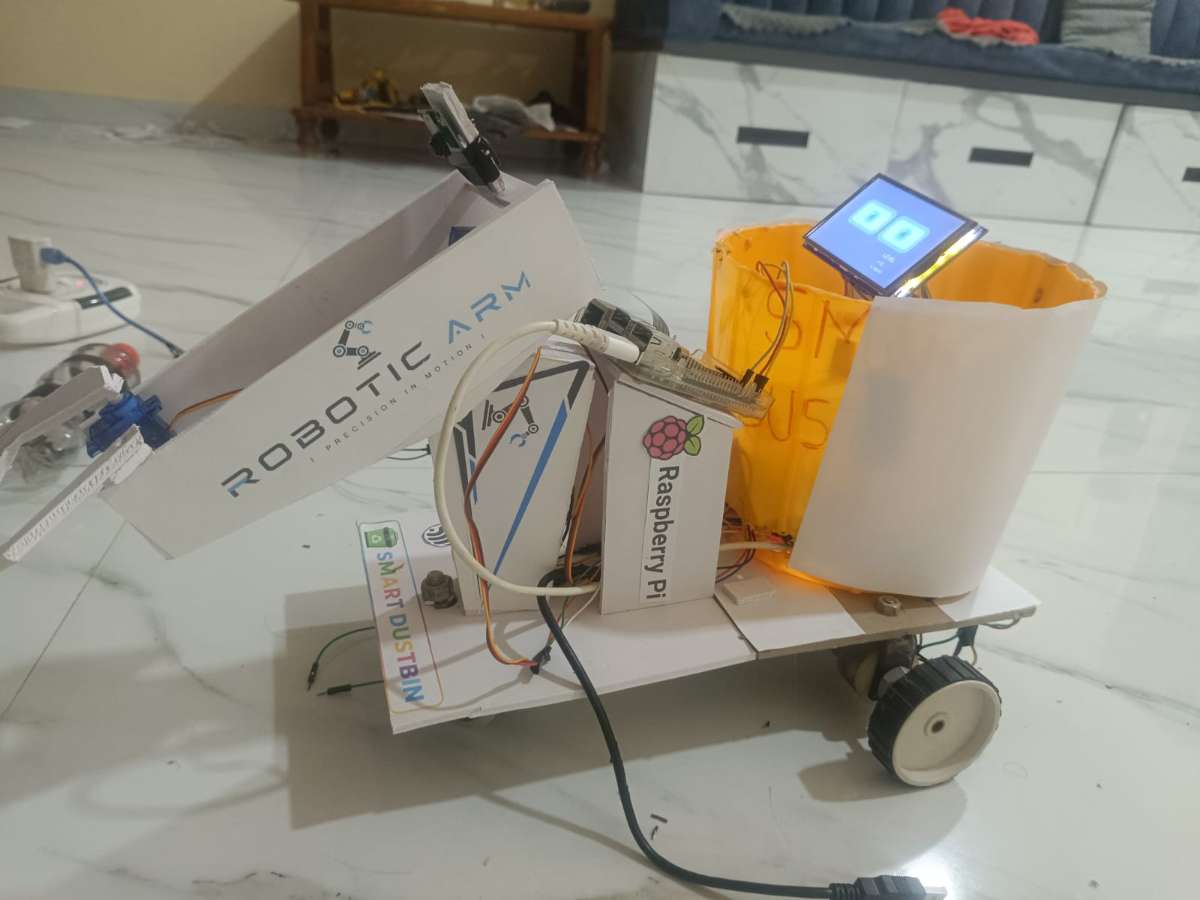
I designed a Smart Robotic Dustbin that can move towards detected waste on its own. Using a camera, sensors, and artificial intelligence, the system identifies trash lying on the ground. A robotic arm then picks up the waste and places it inside the dustbin. In this way, the dustbin actively collects litter instead of waiting for people to throw it away.
.jpeg)
FAILURES I FACED AND OVERCAME THEM :
Developing SmartBin X was a journey filled with challenges, failures, and continuous learning. Initially, I chose the ESP32-CAM module because I was already familiar with it and had successfully built several projects using it. My plan was to use the ESP32-CAM for live video streaming and real-time trash detection.
However, I soon encountered a major obstacle. Although the ESP32-CAM could detect trash correctly, the image processing speed was extremely slow due to its limited RAM and processing power. I spent nearly 15 days optimizing the code, improving the video stream, and trying to run object detection alongside live streaming. Despite all my efforts, the system remained too slow for practical use.
Determined to solve the problem, I spent another 5 days researching online, reading technical articles, and exploring forums. Through my research, I discovered that the main limitation was the ESP32-CAM's hardware resources, particularly its low memory and processing capability.
I then switched to a Raspberry Pi 3 and connected a Raspberry Pi Camera V2, expecting a significant improvement. While the Raspberry Pi performed better than the ESP32-CAM, I still faced delays in real-time object detection. The issue was not the accuracy of detection—the trash was detected correctly—but rather the speed of video processing. Slow processing could cause delays in the movement of motors and the robotic arm, reducing the overall efficiency of SmartBin X.
For the next 3 to 4 days, I worked day and night to optimize the system. Eventually, I realized that the heavy AI processing would run much more efficiently on my laptop server, which had significantly more RAM and computational power. It is important to note that Raspberry Pi devices can handle such tasks, especially newer models like the Raspberry Pi 5. However, I only had access to a Raspberry Pi 3, so I adapted my design accordingly by using the laptop as the main AI server while the Raspberry Pi handled communication and control tasks.
Another major challenge was designing the physical structure of SmartBin X. Since I did not use any 3D-printed components, I built the entire prototype using thick foam sheets and locally available materials. Creating a stable mobile platform, designing the robotic arm, and integrating all electronic components required multiple redesigns. I modified the shape of the robotic arm, the body of the dustbin, and the vehicle chassis several times before arriving at the final design.
These failures taught me that innovation is not about succeeding on the first attempt; it is about learning from every mistake and continuously improving. In total, I spent approximately 25 to 30 days overcoming technical and design challenges. Every failure became a lesson, and every lesson brought me one step closer to creating SmartBin X.
.jpeg)
You can view my video with full detailed and pracical working:
video
https://youtu.be/f-xvfJ9c-Bc?si=AtUx4J2pqJKXUAqb
I wanted to implement:
My goal was to integrate a 3D LiDAR-based mapping and navigation system that would allow SmartBin X to create a 3D representation of its surroundings, move autonomously within a designated area, and efficiently collect waste without human intervention.
.jpeg)
This was a very huge project.....
.jpeg)


