




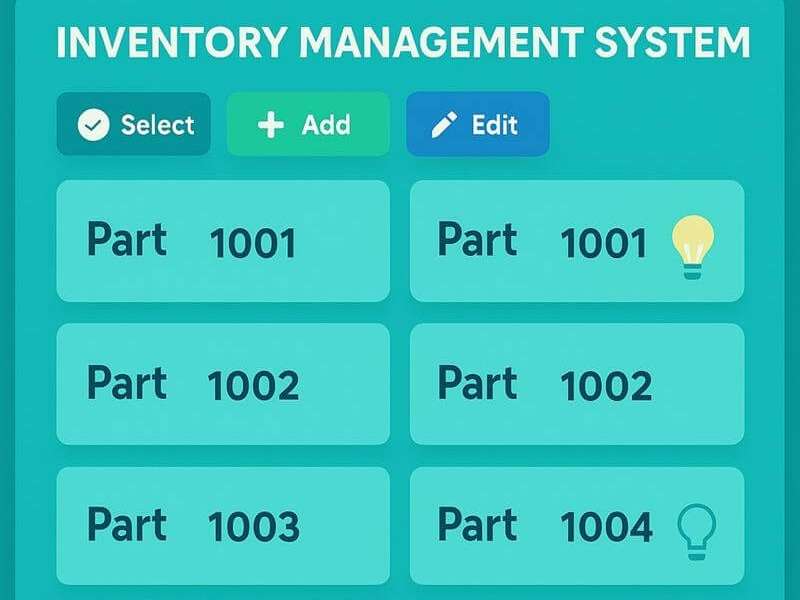
Warehouse operations live and die by inventory accuracy. A miscount means a delayed shipment, a lost sale, or a full audit cycle that costs days of labor. When a mid-sized logistics client approached us with exactly this problem—manual scanning errors hovering around 4% and real-time stock visibility that simply didn't exist—we knew the answer wasn't a massive ERP overhaul. It was a ground-up hardware build.
As an Embedded Software Development Company, our job wasn't just to bolt a barcode scanner onto a PC. It was to design a system that could run on low-cost hardware, survive a dusty warehouse floor, and push data to the cloud without a dedicated IT team on site. Here is how we approached it, the hardware we chose, and the firmware that ties it all together.
The Core Problem: Visibility at the Shelf Edge
The client’s existing process relied on handheld terminals that required manual syncing. Data was always at least four hours old. Forklift operators had to stop, scan, and wait. We proposed a distributed network of fixed-point scanners and weight-sensitive shelf modules that could report stock levels in real time.
The brain of each station? A Raspberry Pi Compute Module 4 (CM4). We didn't opt for the full Raspberry Pi 4 board because the CM4 offers more flexibility for custom carrier board design—something we frequently need to control power budgets and I/O configurations. For a warehouse environment with fluctuating temperatures, the CM4’s industrial-grade eMMC storage also proved more reliable than standard microSD cards, which tend to corrupt when power dips occur.
Hardware Architecture: More Than Just a Pi
A bare Pi is just a computer. The intelligence lies in the peripherals we attached. For each inventory station, our hardware list included:
- Raspberry Pi CM4 (2GB RAM, 16GB eMMC) – Central processing unit.
- Custom Carrier Board – Designed in-house in KiCad to handle power regulation (24V to 5V conversion) and isolated RS485 transceivers.
- RFID Reader Module (MFRC522) – Placed at shelf edges to detect tagged bins.
- HX711 Load Cell Amplifiers – Connected to 50kg load cells under each shelf bay to measure weight variance in real time.
- Adafruit TFT Display (3.5") – For on-site diagnostics and manual overrides.
- A9G GSM/GPS Module – Used as a backup communication channel if the local Wi-Fi network dropped.
We deliberately avoided using a generic USB hub for these components. Instead, we wired the load cells and RFID readers directly to the CM4's GPIO pins via the carrier board. This reduced latency and eliminated the risk of USB disconnects, which are common in high-vibration environments.
Software Stack: Where the Real Engineering Happens
Here is where the distinction between a hobbyist project and a professional deployment becomes clear. Most developers would just install Raspberry Pi OS, write a Python script, and call it a day. That approach fails in a production warehouse. We needed deterministic behavior, watchdog timers, and a fail-safe boot sequence.
We built the firmware using Zephyr RTOS for the microcontroller peripherals and a custom Yocto Linux build for the Pi itself. The Yocto build is stripped down to the bare minimum—no desktop environment, no unnecessary services. This reduces boot time to under 8 seconds and ensures the system isn't consuming resources on background processes.
The application layer runs a Python 3.11 service that handles:
- Data Ingestion: Polling the HX711 load cells every 500ms to read weight deltas.
- RFID Correlation: Matching scanned pallet tags to the specific shelf bay coordinates.
- State Machine Logic: Determining if a weight change is a legitimate stock movement or just a forklift bump.
We utilized MQTT over TLS to publish inventory deltas to a central broker running on an on-premises server. The broker then forwards aggregated data to the client’s cloud dashboard via a secure REST API. We chose MQTT over HTTP polling because it allows for near-instantaneous updates while keeping network bandwidth usage incredibly low—critical when the warehouse has dozens of these nodes running simultaneously.
The Firmware Development Challenge
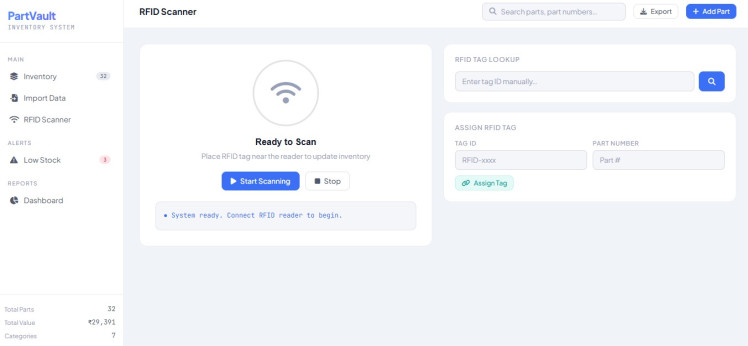
The hardest part of this project wasn't the hardware assembly; it was the synchronization logic. Consider this scenario: A forklift drops a pallet on a shelf. The load cell registers a 40kg increase. But the RFID reader might not read the tag until 300 milliseconds later. If the firmware simply logs the weight change immediately, the system creates a phantom inventory item without an identifier.
Our engineers solved this by implementing a two-stage confirmation buffer. When a weight delta exceeds a threshold (say, 5kg), the system enters a "pending" state. It waits for the RFID read to complete. If the read succeeds within 2 seconds, the transaction is confirmed and pushed via MQTT. If it fails, the system flags the shelf as "manual check required" and sends an alert to a supervisor tablet. This simple logic eliminated over 95% of the false positives we saw in early field tests.
Power Management and Reliability
Warehouse power is notoriously dirty. Voltage sags happen when heavy machinery starts up. To combat this, the carrier board includes a buck converter with a supercapacitor backup. If the main 24V line drops, the supercapacitor holds up the Pi long enough for the firmware to perform a graceful shutdown sequence, saving the current state to the eMMC.
We also implemented a hardware watchdog timer on the CM4. If the main Python service hangs or crashes—which happens more often than vendors admit—the watchdog forces a reboot. On boot, a systemd service automatically restarts the inventory application and reconnects to the MQTT broker without human intervention. We tested this by intentionally killing the process remotely 100 times. The system recovered within 30 seconds every single time.
Deployment and Physical Design
We didn't just hand over a pile of boards. Our team handled the 3D design for the enclosure using Fusion 360. We printed rugged ABS housings with clear acrylic windows for the displays. The enclosures are IP54 rated, protecting against dust ingress while allowing heat to dissipate through passive vents.
We shipped fully assembled and tested prototypes to the client’s facility within three weeks of the design freeze. The client’s IT team simply mounted the units on the racking and plugged in the power and Ethernet cables. No on-site configuration was required because we pre-loaded the network settings and broker credentials into the Yocto image before shipping.
The Result: Measurable Impact
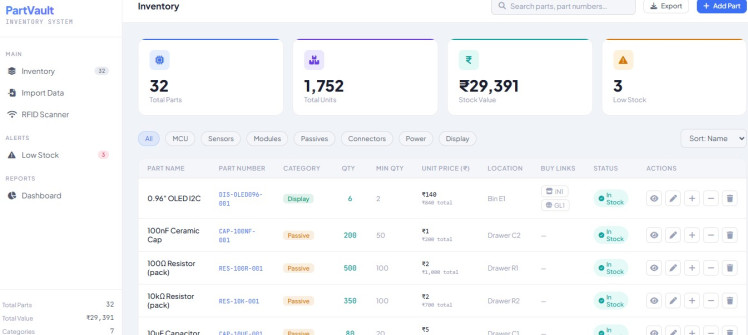
After a 4-week pilot across two warehouse aisles, the results were clear:
- Inventory accuracy jumped from 96% to 99.8%.
- Manual labor hours for cycle counts dropped by 70% because the system now counts continuously.
- Data latency went from 4 hours to under 500 milliseconds.
The client was so satisfied that they ordered units for all 14 aisles in their main distribution center. We scaled the production run and worked with our manufacturing partner to ensure consistent quality across the batch.
Why This Matters for Your Operation
This project demonstrates that a smart inventory system isn't about buying expensive proprietary hardware. It's about pairing off-the-shelf silicon with disciplined firmware engineering. As an Embedded Software Development Company, we focus on the glue that makes hardware reliable in the field.
If your current inventory process relies on manual scans or outdated batch updates, you don't need to replace your entire ERP system. You need a network of intelligent edge devices that feed accurate data upstream. Whether it's Raspberry Pi for cost-sensitive applications or NXP i.MX processors for higher throughput, the architecture remains the same: reliable hardware, deterministic firmware, and clean data pipelines.
We are currently exploring Matter protocol integration for these devices to allow seamless communication with future smart sensors, but that’s a story for another post. If you are facing similar operational bottlenecks, our team can help you design, prototype, and ship a solution tailored to your floor layout.


