



.jpeg)
Smart Battery Monitoring System Using ESP32-C6 & Blynk IoT
Modern electronics projects rely heavily on battery power — but most students do not have professional tools to measure important battery parameters like real-time voltage, current, SoC (State of Charge), or health.
As a result:
- We never know how much capacity the cell actually has
- We don’t know how fast a project drains the battery
- Projects often fail unexpectedly because the battery dies without warning
To solve this real problem, I built a Smart BMS (Battery Monitoring System) using:
- ESP32-C6 (Wi-Fi + IoT)
- INA260 precision current/voltage sensor
- Kalman filtering for noise reduction
- Hybrid SOC estimation (Coulomb Counting + OCV Fusion)
- Blynk IoT dashboard for live monitoring
The result is a low-cost, accurate, real-time battery analyzer that works with any lithium cell.
What This Project Does
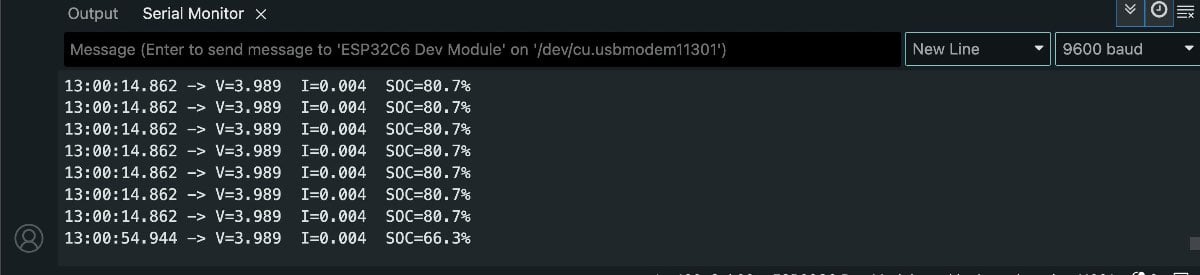
This Smart BMS continuously measures:
- Voltage and current of the battery
- State of Charge (%)
- Live performance graphs through Blynk IoT
This system updates values every second, and shows them on a mobile dashboard, allowing users to monitor a cell from anywhere.
It solves 3 real problems makers commonly face:
(1) No accurate way to measure true battery capacity
Using Coulomb counting, the system can calculate mAh used during a discharge cycle.
(2) No stable readings due to sensor noise
Kalman filtering smoothens voltage & current data.
(3) No way to see battery status remotely
Blynk dashboard shows V, I, SOC in real time.
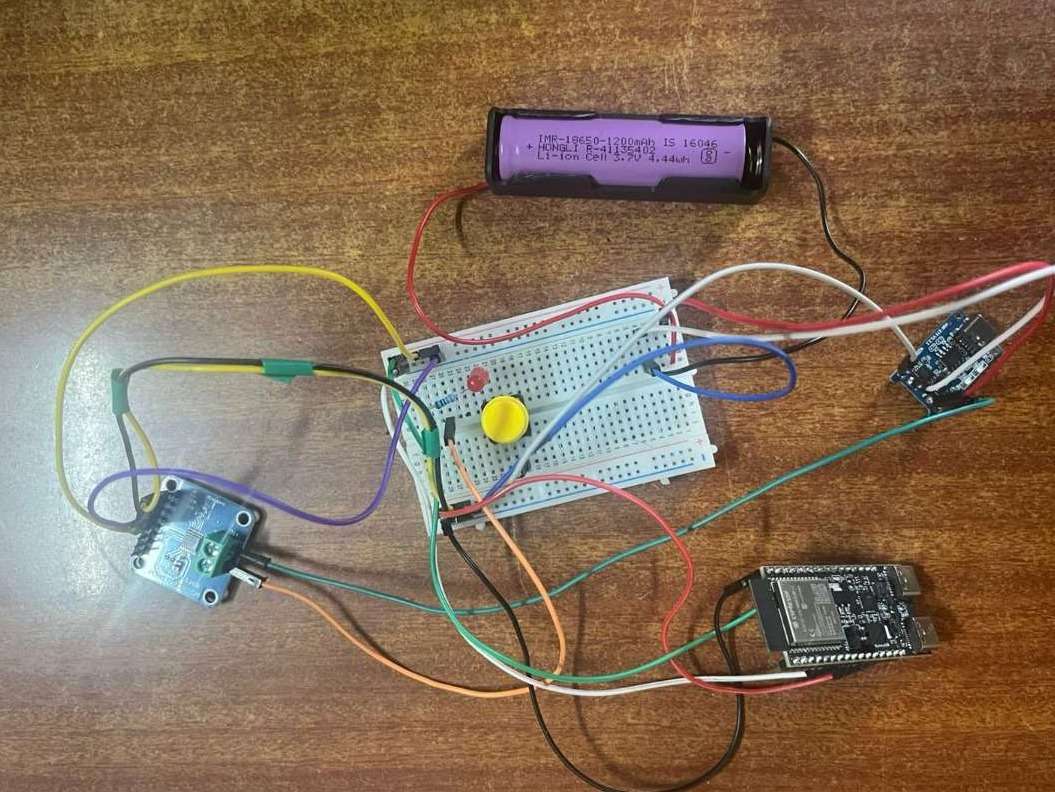
Pin Out and Connections

| INA 260 | |
| cc | 5v from es32 c6 |
| GND | gnd of esp32 c6 |
| SCL | IO 8 |
| SDA | IO 9 |
| TP4056 | |
| B+ | +ve of cell |
| B- | -ve of cell |
| OUT+ | in+ of INA260 |
| OUT- | -ve of push button |
How the System Works
1. INA260 Sensor Measures the Battery
- The INA260 provides millivolt-accurate voltage
- And milliamp-accurate current (both directions)
- ESP32-C6 reads these values through I²C pins (SDA=9, SCL=8)
These raw readings tend to be noisy, especially with small loads — that’s where filtering helps.
2. Noise Reduction Using a 2-State Kalman Filter
The code includes a lightweight bias-aware Kalman filter:
- Removes electrical noise
- Corrects drift
- Stabilises millivolt-level readings
So the dashboard always shows smooth, realistic data.
3. SOC Calculation Using Two Methods
To get accurate battery percentage, the system blends:
-Coulomb Counting
Measures current over time (Ah = ∫I dt)
→ Tracks how much charge is consumed
-OCV Estimation (Open Circuit Voltage)
A lookup table maps voltage to SOC based on 18650 cell characteristics.
-Fusion Algorithm
SOC = 97% Coulomb Counting + 3% OCV
This prevents drift and keeps percentage realistic.
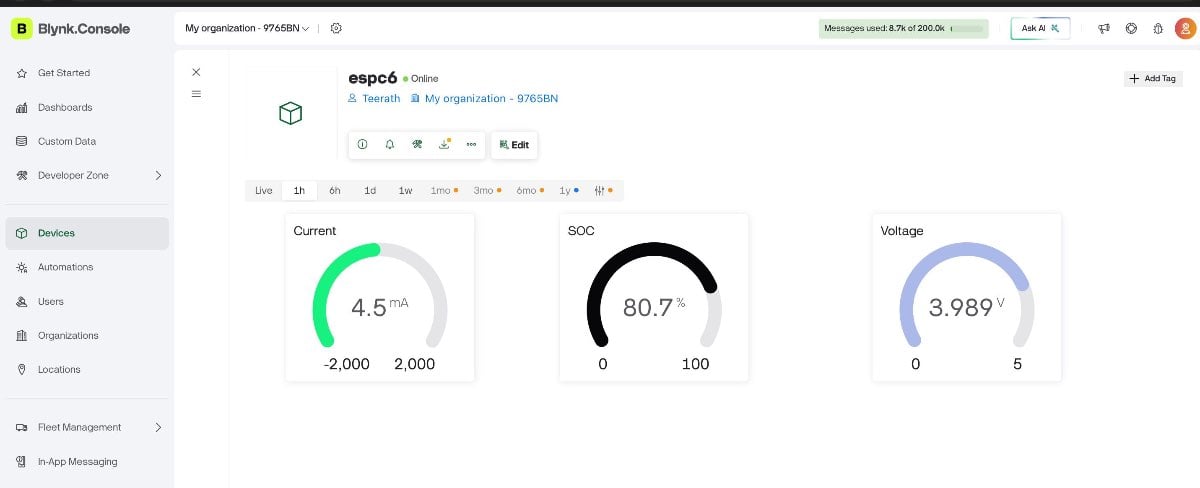
4. IoT Dashboard Using Blynk
The ESP32-C6 connects to Wi-Fi and updates:
- Voltage → V0
- Current → V1
- SOC → V2
Data is sent once per second so the cloud stays stable.
The dashboard shows:
- Gauges for Voltage, Current, SOC
- Real-time streaming
- Works from any location
Key Features of the Code
- Stable 1-second updates (cloud-safe)
- I²C protection + fast sampling
INA260 configured for reliability:
- 64-sample averaging
- 1.1ms conversion time
- Kalman filters for V & I :Smooths out micro-fluctuations.
- Hybrid SOC algorithm :Much more accurate than using only voltage.
- Remote monitoring :Fully functional IoT BMS using your phone.
Conclusion
This Smart BMS transforms a regular 18650 cell into a fully monitored IoT power source.
With precise sensing, noise filtering, battery modelling, and cloud connectivity,
this project brings professional-grade battery analytics into the hands of students and hobbyists.
It is simple to build, inexpensive, and extremely practical —
and solves a very real problem:
“We all use batteries in our projects, but we rarely understand them.
This project finally makes battery health measurable, visible, and smart.”
DigiKey MyList- https://www.digikey.in/en/mylists/list/RVAA12S7JW


