


Introduction
Sleep bruxism is a sleep-related movement disorder characterized by involuntary grinding or clenching of teeth during sleep. Continuous bruxism can lead to tooth wear, jaw pain, headaches, and temporomandibular joint disorders (TMJ). Conventional diagnostic techniques such as Electromyography (EMG) and Polysomnography (PSG) provide accurate results but are expensive, complex, and unsuitable for long-term home monitoring.
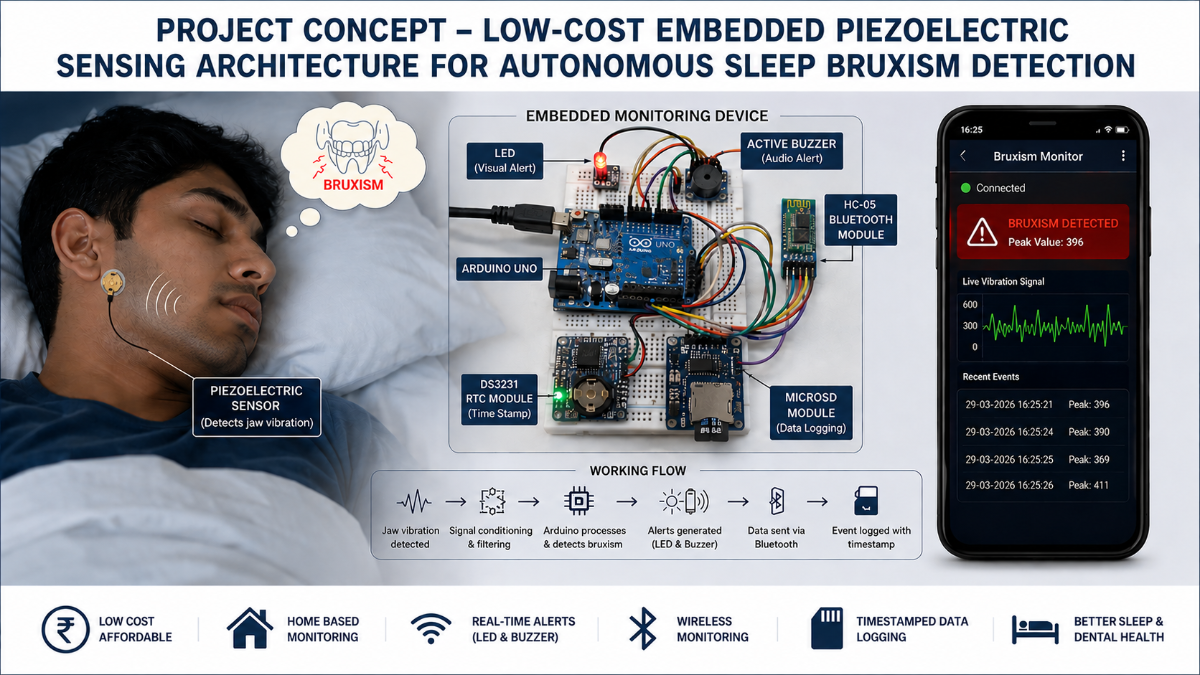
To address this challenge, this project presents a low-cost embedded piezoelectric sensing architecture capable of detecting jaw vibrations associated with sleep bruxism. The system performs real-time monitoring, event detection, alert generation, wireless communication, and timestamped data logging.
System Block Diagram
.jpg)
System Workflow
- Piezoelectric sensor detects jaw vibration.
- Signal conditioning circuit filters and stabilizes the signal.
- Arduino UNO continuously monitors sensor values.
- Threshold-based algorithm identifies bruxism events.
- LED and buzzer provide immediate alerts.
- HC-05 Bluetooth module transmits data wirelessly.
- RTC module provides accurate timestamps.
- MicroSD module stores event data for future analysis.
Step 1: Problem Identification
Sleep bruxism often remains undiagnosed because conventional monitoring equipment is costly and requires clinical supervision. The objective of this project was to develop a portable and affordable embedded solution capable of detecting grinding and clenching activities in real time.
Objectives
- Detect jaw vibrations using a piezoelectric sensor.
- Identify bruxism events using threshold analysis.
- Generate local alerts.
- Transmit data wirelessly.
- Store event history with timestamps.
- Provide a low-cost alternative to expensive monitoring systems.
Step 2: Component Selection
The following components were selected for implementing the system:
| Component | Purpose |
|---|---|
| Arduino UNO | Main controller |
| Piezoelectric Sensor | Jaw vibration sensing |
| HC-05 Bluetooth Module | Wireless communication |
| DS3231 RTC Module | Time stamping |
| MicroSD Module | Data logging |
| LED | Visual alert |
| Active Buzzer | Audio alert |
| Resistors | Signal conditioning |
| Capacitors | Noise filtering |
| Breadboard | Prototype assembly |
| Jumper Wires | Connections |
Step 3: Circuit Design
The piezoelectric sensor generates voltage when subjected to vibration. Since the sensor output contains noise and transient spikes, a signal-conditioning network consisting of resistors and capacitors was implemented.
Signal Conditioning Components
- 1 MΩ resistor for discharge path.
- 100 kΩ resistor for voltage stabilization.
- 0.1 µF capacitor for noise filtering.
- 10 µF capacitor for smoothing fluctuations.
The conditioned signal is then connected to the analog input of the Arduino UNO for processing.
Step 4: Hardware Assembly
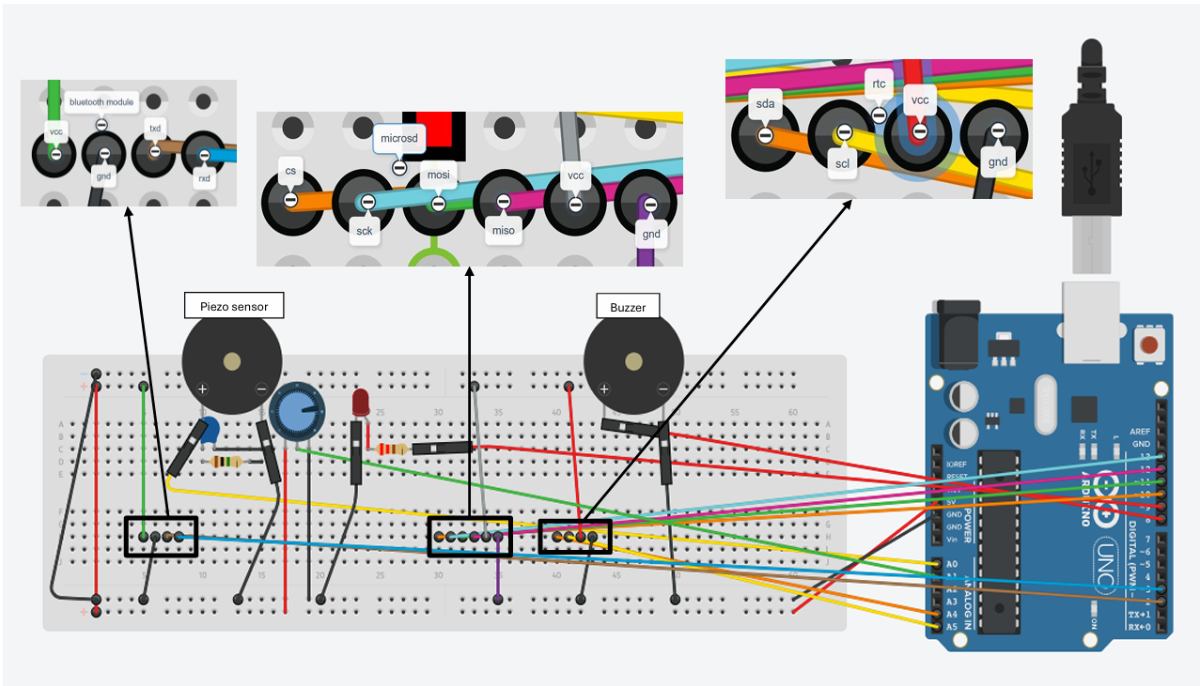
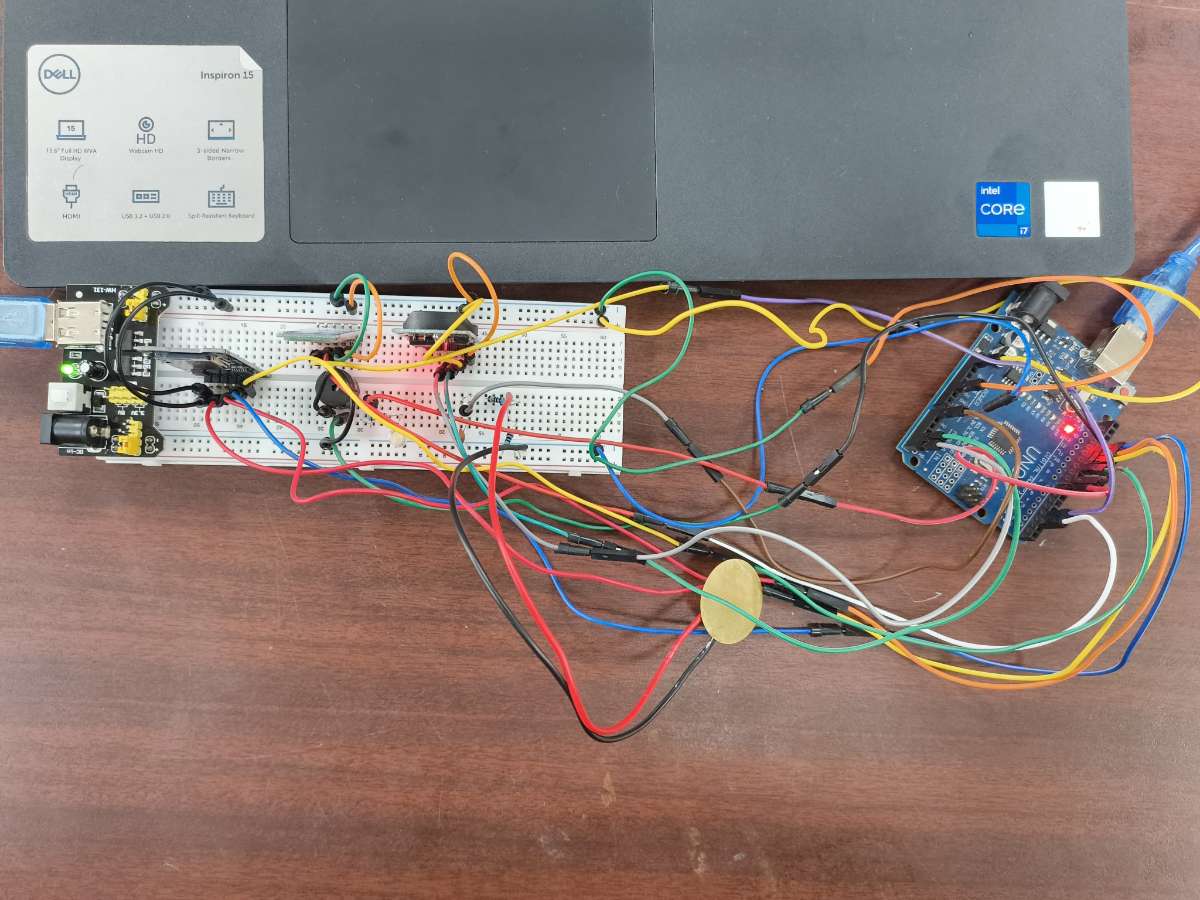
The hardware prototype was assembled on a breadboard.
Connections
- Piezo Sensor → A0
- LED → D8
- Buzzer → D9
- HC-05 Bluetooth Module → Software Serial Pins
- RTC Module → I2C Interface
- MicroSD Module → SPI Interface
All modules were integrated and tested individually before final system integration.
Step 5: Software Development
The firmware was developed using Arduino IDE.
Major Functions Implemented
- Sensor data acquisition
- Peak value calculation
- Threshold comparison
- Bruxism event detection
- LED activation
- Buzzer activation
- Bluetooth transmission
- RTC timestamp generation
- MicroSD data storage
Detection Algorithm
- Read analog value from piezo sensor.
- Calculate vibration peak.
- Compare with threshold value.
- If threshold exceeded:
- Trigger LED.
- Trigger buzzer.
- Send Bluetooth notification.
- Save event to MicroSD card.
Step 6: Sensor Testing
The piezoelectric sensor was tested using simulated jaw-clenching and grinding activities.
Several trials were conducted to observe sensor response under different vibration intensities.
Observations
- Small jaw movements produced low sensor peaks.
- Strong clenching generated higher amplitudes.
- Grinding activities consistently exceeded threshold values.
Step 7: Real-Time Bruxism Detection
When the measured vibration peak exceeded the predefined threshold, the system classified the activity as a bruxism event.
The event detection process involved:
- Capturing sensor peak.
- Comparing against threshold.
- Activating visual alert.
- Activating audible alert.
- Logging event information.
Step 8: Bluetooth Monitoring
The HC-05 Bluetooth module was integrated to enable wireless monitoring.
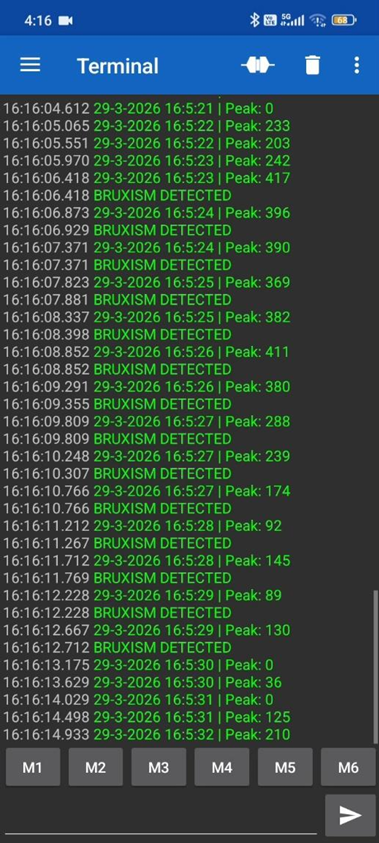
Detected events were transmitted to a smartphone application in real time.
Benefits
- Remote monitoring
- Wireless data access
- Portable operation
- Improved user convenience
Step 9: Data Logging
A DS3231 RTC module and MicroSD card module were incorporated to maintain historical records of detected events.
For every detected bruxism event:
- Date is recorded.
- Time is recorded.
- Peak vibration value is recorded.
Example Log Entry
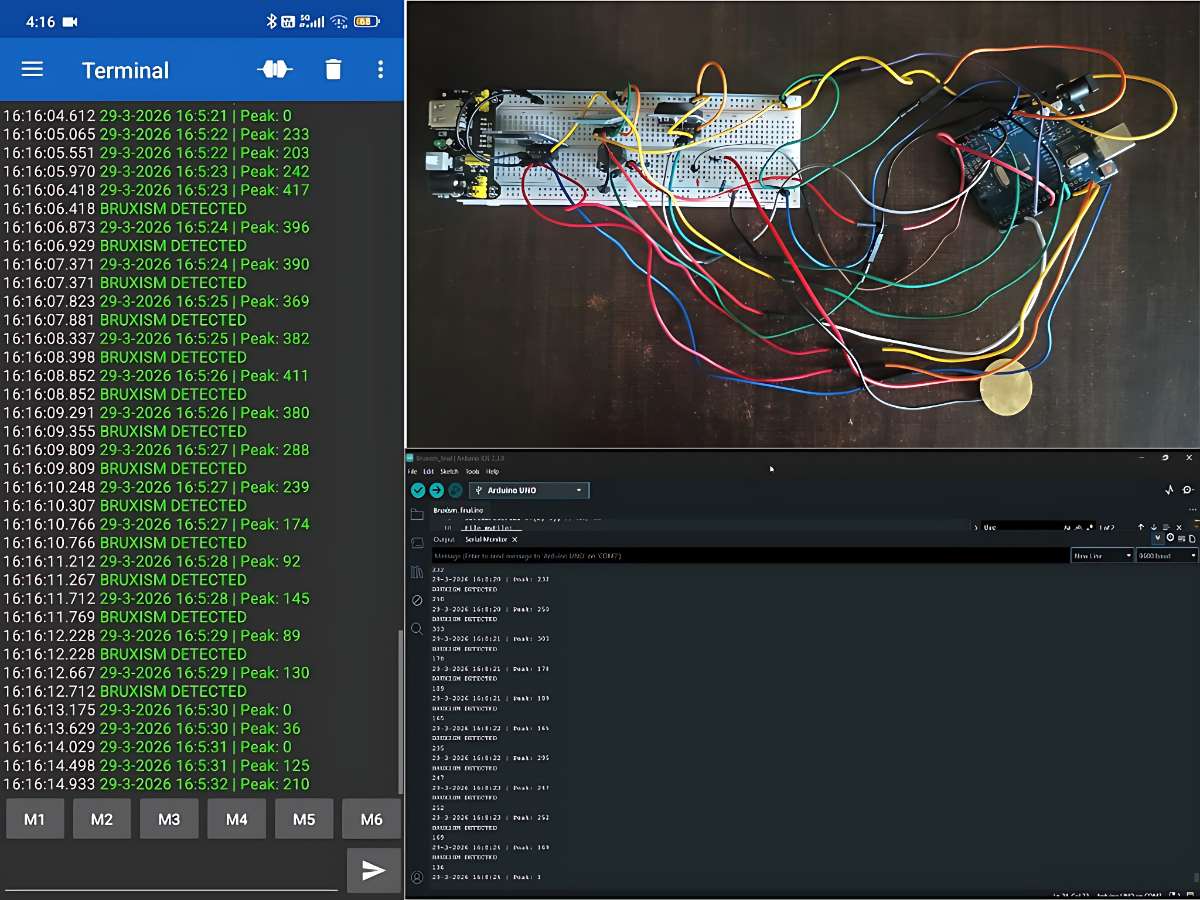
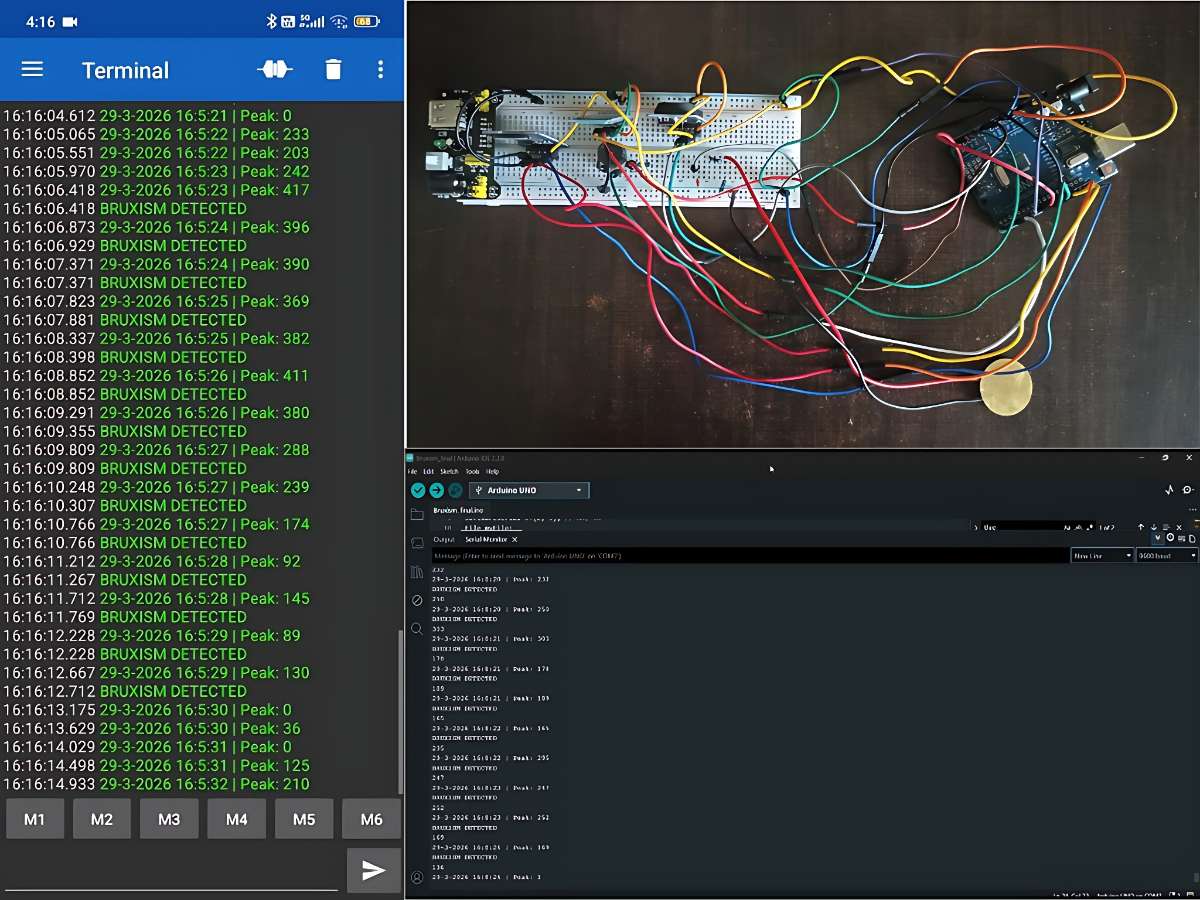
29-03-2026 16:25:21 | Peak: 396 | BRUXISM DETECTED
29-03-2026 16:25:24 | Peak: 390 | BRUXISM DETECTED
29-03-2026 16:25:25 | Peak: 369 | BRUXISM DETECTED
Experimental Results
The system was tested under different vibration conditions.
| Test Condition | Peak Range | Detection |
|---|---|---|
| No Movement | 0–40 | No |
| Mild Jaw Motion | 50–80 | No |
| Clenching | 80–200 | Sometimes |
| Strong Clenching | 300–450 | Yes |
| Grinding | 350–500 | Yes |
The system successfully differentiated normal jaw motion from intense grinding and clenching activities.
.png)
Advantages
- Low-cost implementation
- Portable architecture
- Real-time operation
- Wireless monitoring
- Timestamped logging
- Easy hardware integration
- Suitable for home monitoring
Future Improvements
- Integration with mobile application.
- Cloud-based data synchronization.
- Machine learning-based classification.
- Rechargeable battery-powered operation.
- Wearable dental monitoring device.
- Detection of severity levels of bruxism.
Conclusion
A low-cost embedded piezoelectric sensing architecture for autonomous sleep bruxism detection was successfully designed and implemented. The system demonstrated reliable detection of grinding and clenching activities using a piezoelectric sensor and threshold-based processing. Real-time alerts were generated through LED and buzzer outputs, while Bluetooth communication enabled wireless monitoring. Integration of RTC and MicroSD modules provided timestamped event logging for long-term analysis. The developed prototype offers an affordable, portable, and scalable solution for home-based sleep bruxism monitoring and has potential for future wearable healthcare applications.