




Development Methodology of SmartDrop
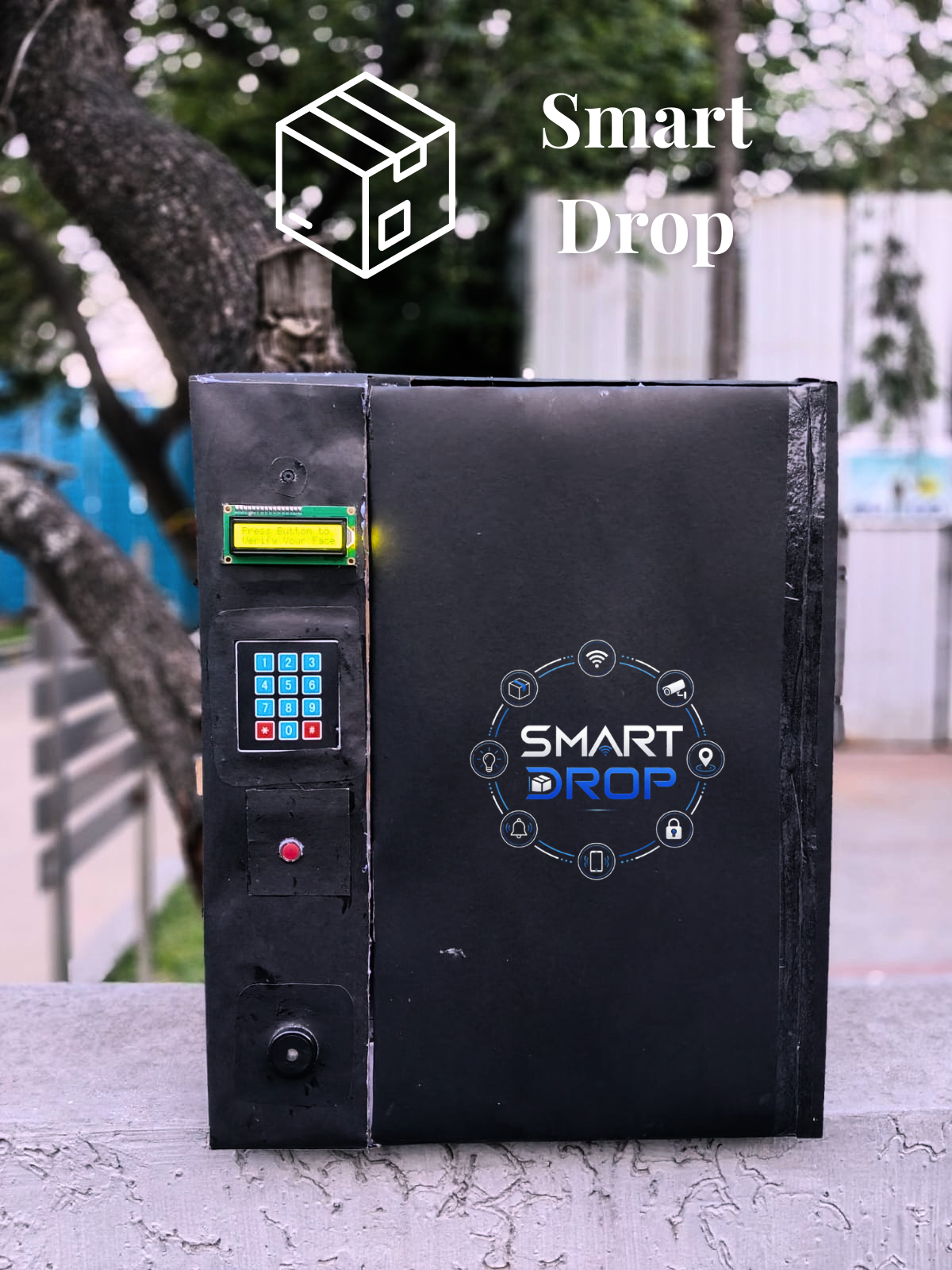
Demonstration Video
Problem-Solution Discussion
The rapid growth of e-commerce and online shopping has significantly increased the number of parcel deliveries worldwide. While this has improved convenience for customers, it has also introduced several challenges such as parcel theft, missed deliveries, unauthorized access, lack of delivery verification, and limited real-time monitoring. Traditional delivery methods often rely on recipients being available at the time of delivery, and parcels are frequently left unattended when recipients are absent, increasing the risk of theft or damage. These challenges highlight the need for a secure, automated, and intelligent parcel management system that can ensure safe delivery, provide delivery verification, enhance user convenience, and improve overall delivery reliability.
Problem 1: Parcel Theft and Unauthorized Access
With the rapid growth of e-commerce and online shopping, parcel deliveries have become an essential part of daily life. However, the increasing volume of deliveries has also led to concerns regarding parcel security, especially when packages are left unattended outside homes or apartments.
Specific Issue:
Traditional parcel deliveries often involve leaving packages unattended, making them vulnerable to theft, tampering, and unauthorized access.
Solution:
SmartDrop provides a secure delivery compartment protected through face verification, OTP authentication, and automated locking mechanisms. Only authorized users can access the parcel, significantly improving delivery security.
Problem 2: Missed Deliveries Due to Recipient Unavailability
Modern lifestyles often prevent recipients from being available at the exact time of delivery. This creates challenges for both customers and courier services.
Specific Issue:
Recipients are frequently unavailable during delivery, resulting in failed delivery attempts, delays, and additional logistics costs.
Solution:
SmartDrop enables delivery personnel to securely deposit parcels inside the box even when the recipient is absent. The user can retrieve the parcel later through the mobile application.
Problem 3: Lack of Delivery Verification
As delivery systems become increasingly automated, customers expect reliable proof that their parcel has been delivered safely and accurately.
Specific Issue:
Conventional delivery systems may not provide sufficient evidence that a parcel was successfully delivered and placed in a secure location.
Solution:
The system uses an ultrasonic sensor to confirm parcel placement and requires the delivery person to upload an image of the parcel inside the box. This information is stored and displayed in the user application as proof of delivery.
Problem 4: Tampering and Security Threats
Secure storage systems must be capable of detecting and responding to unauthorized access attempts to protect valuable parcels.
Specific Issue:
Delivery boxes may be subjected to forceful opening attempts, vandalism, or unauthorized handling.
Solution:
A vibration sensor continuously monitors the box for tampering activities. If abnormal vibrations are detected, the camera captures an image and sends an alert notification to the user.
Problem 5: Unauthorized Relocation of the Delivery Box
For outdoor installations, there is always a possibility of the delivery box being moved, relocated, or stolen without the owner's knowledge.
Specific Issue:
A delivery box may be displaced or stolen, making parcel recovery difficult.
Solution:
A GPS module continuously tracks the location of the SmartDrop box. If the box is moved beyond a predefined range, the user receives an immediate notification through the application.
Problem 6: Lack of Real-Time Monitoring
Users increasingly expect transparency and real-time updates regarding the status of their deliveries.
Specific Issue:
Users often have limited visibility regarding parcel status, security events, and retrieval activities after delivery.
Solution:
SmartDrop utilizes Firebase cloud services to provide real-time updates on authentication status, parcel placement, image uploads, security alerts, GPS location, and retrieval activities through the mobile application.
Discussion of Project Flow and Suitable Tools
The development of SmartDrop began by addressing common challenges in parcel delivery, including parcel theft, missed deliveries, and the absence of secure delivery systems. A suitable delivery box was selected, and essential hardware components such as the ESP32, camera module, ultrasonic sensor, vibration sensor, servo motors, GPS module, and supporting electronics were integrated into the system.
Flow of the Project
The delivery process starts when the delivery person selects a parcel in the mobile application and navigates to the destination. Upon arrival, the delivery person selects the "Reached Destination" option, initiating the face verification process. After pressing the verification button on the SmartDrop box, the captured image is sent to a Node.js server for AI-based face verification. Once verified, an OTP is generated and sent to the delivery person's application.
After entering the OTP, the recipient receives a "Pay & Open Box" option in the application. The user completes the payment, where the delivery person's profit is released immediately while the remaining amount is held until successful parcel placement and box closure. Following payment, the box opens automatically, allowing the delivery person to place the parcel inside. The ultrasonic sensor confirms parcel placement and updates the status to Firebase. The delivery person then uploads an image of the parcel as proof of delivery, after which the box closes automatically, completing the delivery process.
For parcel retrieval, the user selects the "Retrieve Parcel" option in the application. Since the user's device is already authenticated, no additional verification is required. The box opens, allowing parcel collection, and automatically closes after a 10-second interval.
To enhance security, a vibration sensor detects tampering attempts and triggers the camera to capture an image while simultaneously notifying the user. A GPS module continuously monitors the box location and sends alerts if unauthorized movement is detected.
The system was developed using embedded programming, Node.js services, Firebase cloud integration, and mobile application development. Firebase serves as the central platform for real-time communication between sensors, authentication modules, cloud services, and applications. After integrating all hardware and software components, a fully functional SmartDrop prototype was developed, demonstrating a secure, automated, and intelligent parcel delivery and retrieval system.
How We Proceeded with the Project:
Sensor Connections → Arduino IDE Coding → Individual Testing → Module Integration → Complete Workflow Implementation.
Hardware Integration and Software Development
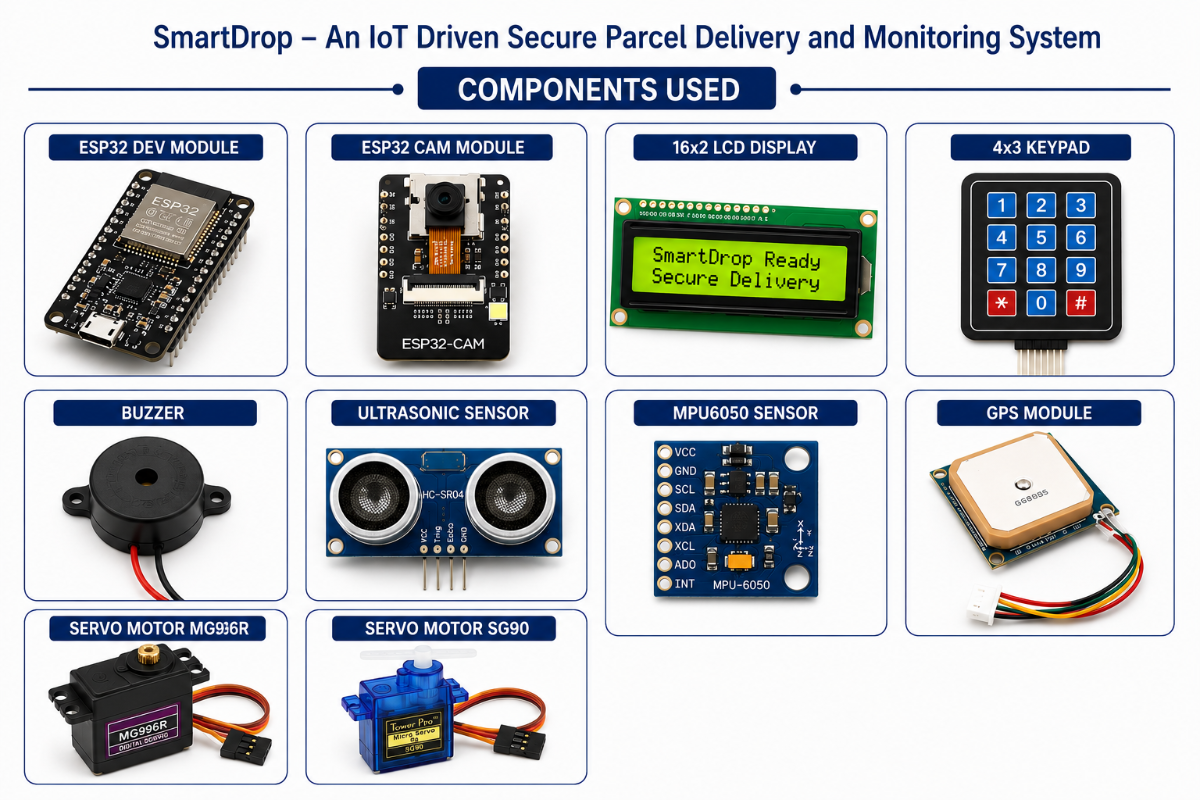
After finalizing the system architecture and selecting the required hardware components, the implementation phase commenced with hardware integration and sensor interfacing. Each module was carefully connected to the ESP32 microcontroller according to the designed circuit architecture. The integrated components included the ESP32-CAM module, ultrasonic sensor, MPU6050 vibration sensor, GPS module, 16×2 LCD display, 4×3 keypad, buzzer, LED indicators, MG996R and SG90 servo motors, and other supporting peripherals. Individual testing was performed for every component to validate electrical connections, communication protocols, sensor accuracy, and actuator responsiveness before proceeding to system-level integration.
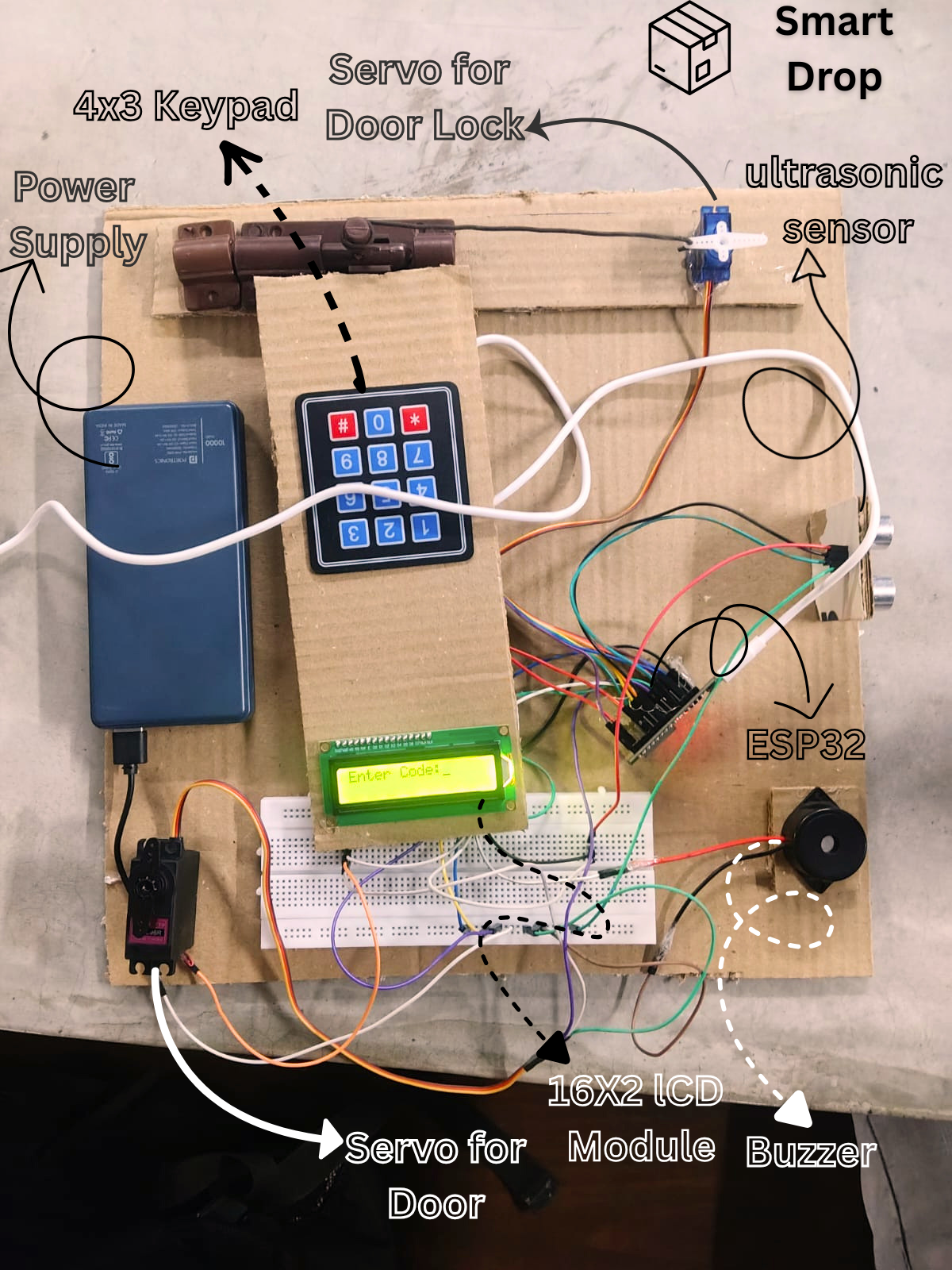
above image is just the simple flow of the prototype (without integration of the of user-- delivery person application)
Following successful hardware validation, firmware development was initiated using the Arduino IDE. The software development process adopted a modular approach, where dedicated programs were first developed and tested for each hardware component independently. This approach enabled efficient debugging and ensured reliable operation of every subsystem before integration into the complete SmartDrop framework.
The implementation process began with the development of core authentication mechanisms, including face verification and OTP validation. The ESP32-CAM module was programmed to capture images, which were transmitted to a Node.js server for AI-based facial recognition. Once authentication was successfully established, OTP generation and verification functionalities were implemented to provide an additional layer of security during the delivery process.
Subsequently, automation functionalities were developed by interfacing the MG996R and SG90 servo motors with the ESP32 controller. These motors were programmed to perform door opening, closing, locking, and unlocking operations based on authentication status and user commands received through the mobile application. The ultrasonic sensor module was then integrated to detect the presence of a parcel inside the delivery compartment and automatically update the parcel status to the cloud database.
To provide delivery confirmation and proof of parcel placement, image capture and cloud upload functionalities were incorporated into the system. Additional security features were implemented through the MPU6050 vibration sensor, which continuously monitors unauthorized tampering attempts. Upon detecting abnormal vibrations, the ESP32-CAM automatically captures an image and triggers an alert notification to the user. Furthermore, the GPS module was integrated to continuously monitor the geographical location of the SmartDrop box and generate alerts if unauthorized relocation is detected.
The cloud infrastructure was developed using Firebase, which served as the central communication platform for real-time data synchronization between hardware modules, cloud services, and mobile applications. Sensor readings, authentication results, parcel information, GPS coordinates, image uploads, and security alerts were continuously exchanged and stored within the Firebase database. A Node.js server was employed to manage facial recognition operations and facilitate communication between the embedded system and cloud environment.
.png)
.png)
Above first image is of delivery person application and second one is of user
After successful development of individual modules, all hardware and software subsystems were integrated into a unified platform. Extensive testing was conducted to verify end-to-end functionality, including authentication, payment processing, parcel detection, image verification, door automation, GPS tracking, tamper detection, notification delivery, and parcel retrieval operations. Through systematic integration and validation, a fully functional SmartDrop prototype was successfully developed, demonstrating a secure, intelligent, and automated parcel delivery and monitoring system.
Vibration Monitoring and Tamper Detection System
The SmartDrop system uses a vibration sensor to continuously monitor the delivery box for tampering and unauthorized access attempts. The sensor readings are compared with a predefined threshold value, and the ESP32 updates the status as LOW (normal) or HIGH (tampering detected) in Firebase.
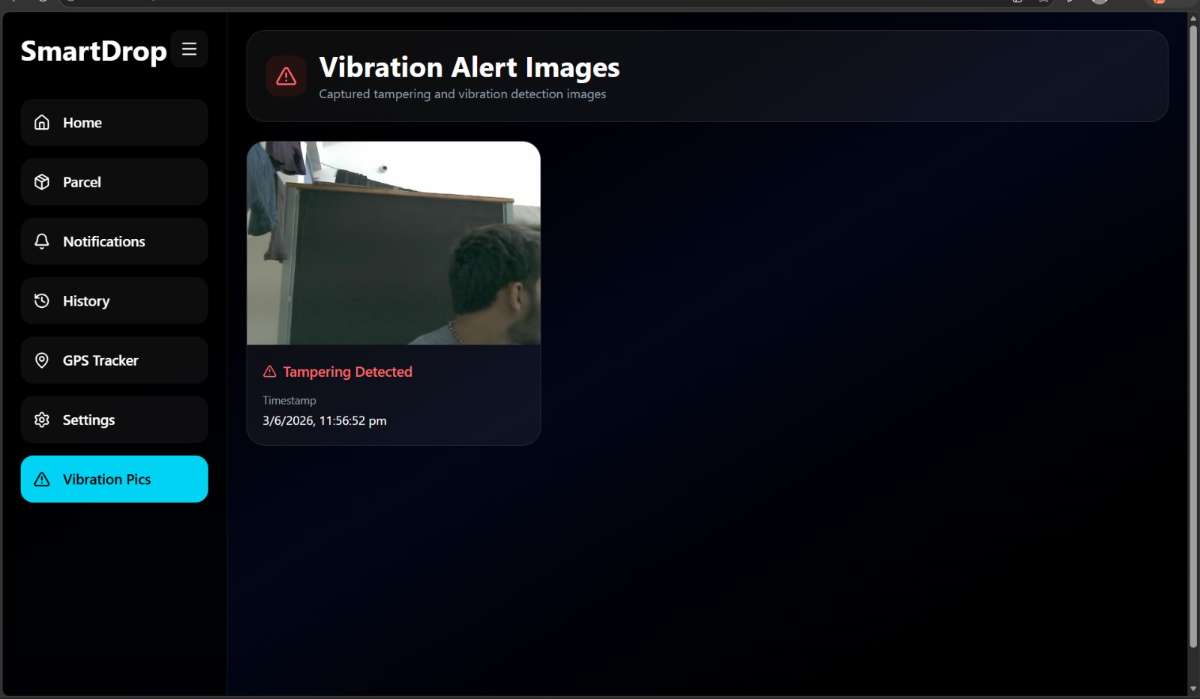
When the vibration exceeds the threshold, the ESP32 triggers the ESP32-CAM to capture an image and upload it to Firebase along with the tamper status. The user application's backend retrieves this information from Firebase and sends it to the frontend, where an alert notification and the captured image are displayed to the user. This enables real-time tamper detection and enhances the security of the SmartDrop system.
GPS Tracking System
The SmartDrop system uses a GPS module to continuously monitor the location of the delivery box. The GPS module collects real-time coordinates and sends them to the ESP32, which uploads the data to Firebase through a Wi-Fi connection.The user application's backend retrieves the GPS data from Firebase and sends it to the frontend, where the box location is displayed on an interactive map along with latitude, longitude, displacement, and system status.
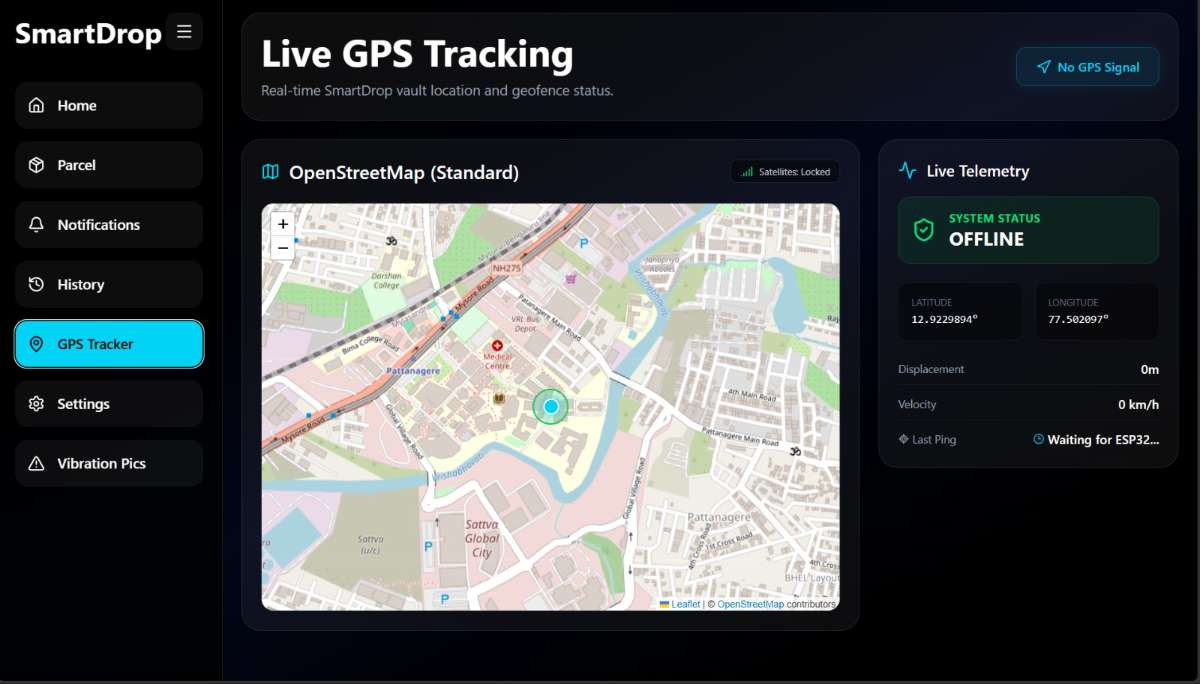
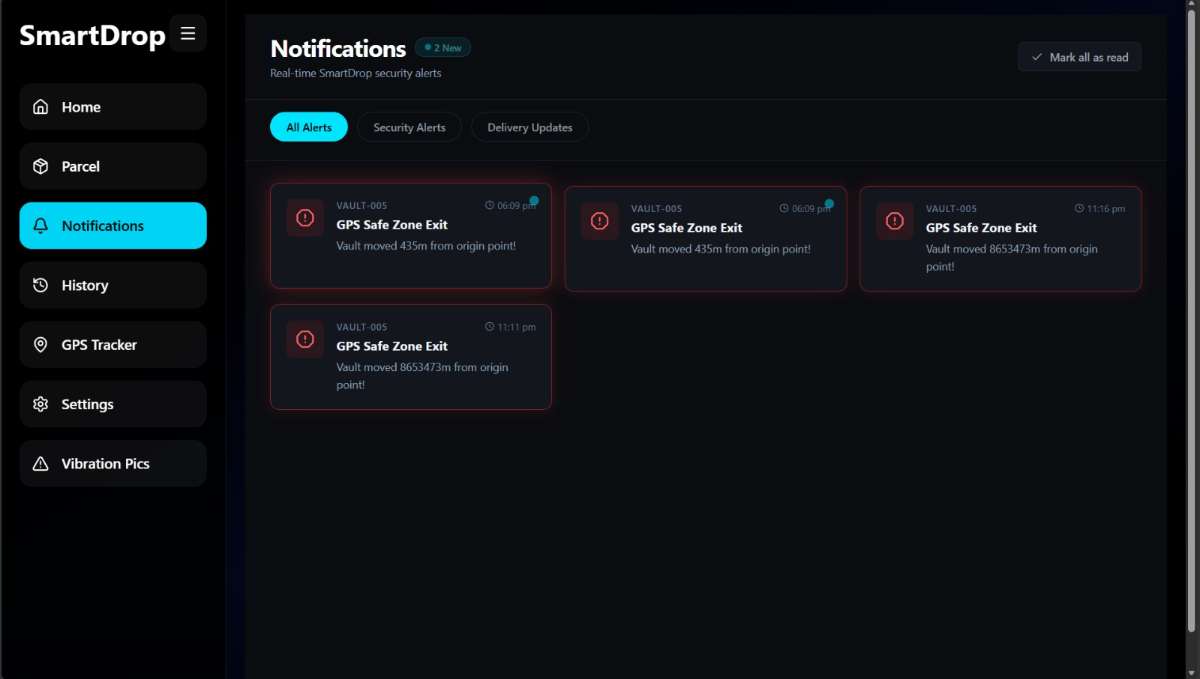
During normal operation, the system displays a secure status. If the SmartDrop box moves beyond the predefined geofencing range, the status changes to red and a pop-up alert is sent to the user, indicating possible misplacement, unauthorized relocation, or theft of the box. This feature provides real-time location monitoring and enhances system security.
Face Verification System :
The Face Verification System serves as the primary authentication mechanism for delivery personnel within the SmartDrop system. Its purpose is to ensure that only authorized delivery personnel can initiate the parcel delivery process, thereby enhancing the overall security of the system.
When the delivery person arrives at the destination and selects the "Reached Destination" option in the mobile application, the face verification process is initiated. By pressing the verification button mounted on the SmartDrop box, the ESP32-CAM module captures an image of the delivery person. The captured image is then transmitted to a Node.js server, where AI-based facial recognition algorithms compare the live image with the pre-registered reference image stored in the database.
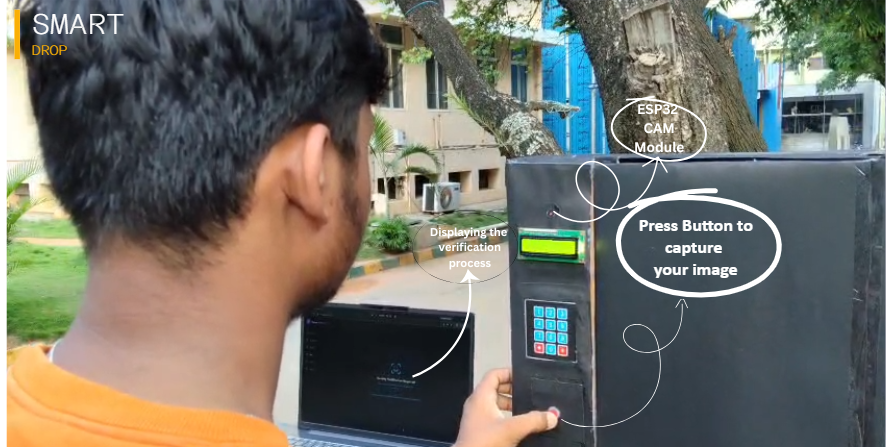
how delivery person's face going to be verified
If a successful match is obtained, the delivery person's identity is verified and an OTP is generated for the next stage of authentication. If the verification fails, access to the delivery process is denied, preventing unauthorized individuals from interacting with the SmartDrop system.
By combining facial verification with OTP authentication, SmartDrop implements a multi-layered security approach that significantly reduces the risk of unauthorized access and ensures that deliveries are handled only by authenticated personnel.
Introducing the Payment System
To enhance transaction security and provide a seamless delivery experience, a payment system was integrated into both the user and delivery person applications. After successful face verification and OTP authentication, the user is granted access to the "Pay & Open Vault" option within the application. Upon selection, the user is redirected to a payment interface where the order details and payable amount are displayed, allowing the transaction to be completed using a suitable payment method.
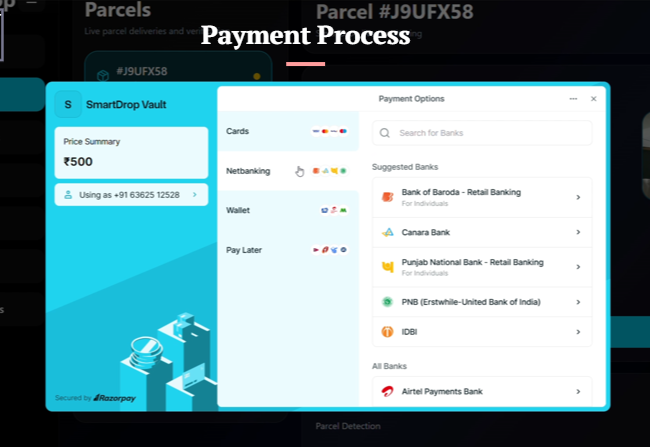
Above image will processed in the user interface for proceed the payment
During this process, the delivery person receives a notification indicating that payment verification is in progress. Once the payment is successfully processed, the delivery person's application is updated with the payment status and profit details.
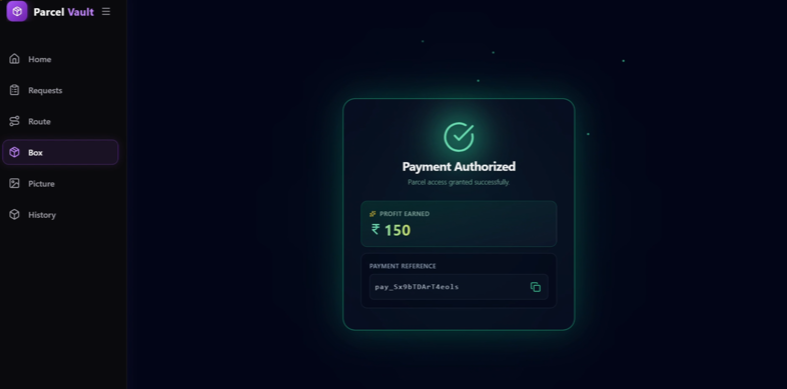
Above image is displaying the profit of the delivery person in his interface
To ensure secure delivery completion, a portion of the transaction is temporarily held and released only after the parcel has been successfully placed inside the SmartDrop box and the door has been securely closed.
This payment mechanism establishes trust between the user and delivery person while ensuring that both the financial transaction and parcel delivery process are completed successfully and securely.
Designing and Building the Project Prototype
After completing the system design and workflow planning, the development of the SmartDrop prototype was initiated. A suitable delivery box was selected based on the required dimensions, structural strength, and ability to accommodate all electronic components while providing adequate storage space for parcels. The internal layout of the box was carefully planned to ensure proper placement of sensors, actuators, and communication modules without affecting parcel storage capacity.
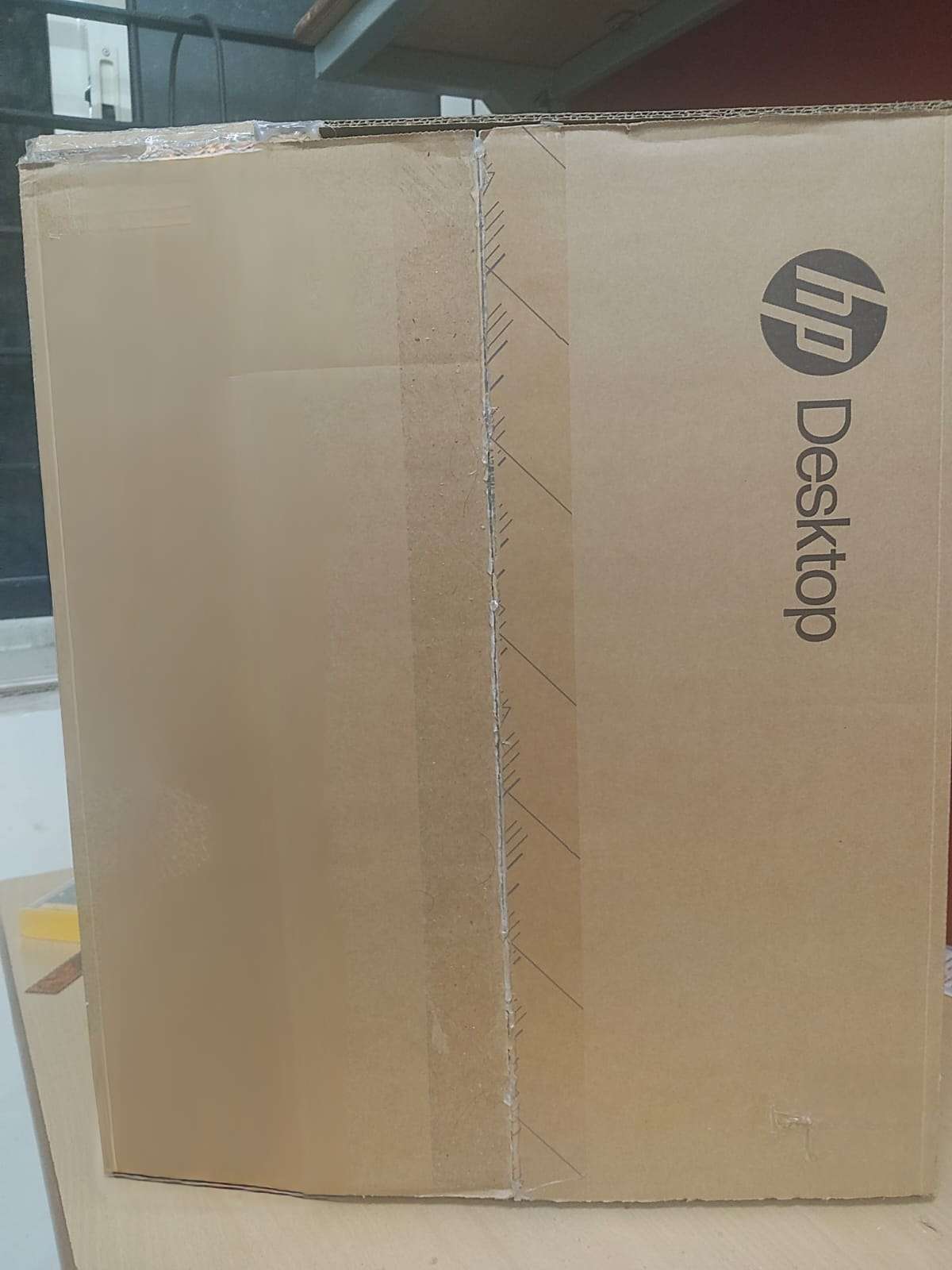
Raw material which we used to build prototype
.jpeg)
Prototype in the building progress
The ESP32 controller, ESP32-CAM module, ultrasonic sensor, MPU6050 vibration sensor, GPS module, LCD display, keypad, buzzer, LEDs, and servo motors were strategically positioned within the box to maximize functionality and accessibility. Special attention was given to the placement of the camera module for effective face verification and tamper monitoring, while the ultrasonic sensor was positioned to accurately detect parcel placement. The GPS module was installed within the enclosure to facilitate continuous location tracking of the delivery box.
The mechanical structure of the prototype was designed to support automated door operation using the MG996R and SG90 servo motors. Appropriate mounting mechanisms were developed to ensure reliable opening, closing, locking, and unlocking of the delivery compartment. Wiring and power distribution were organized systematically to enhance safety, maintainability, and overall system reliability.
.png)
After completing the hardware installation, the external appearance of the prototype was improved using a monochromatic design theme and custom labels to provide a professional finish. The final prototype successfully integrated hardware, software, cloud services, and mobile applications into a compact and functional Smart Parcel Delivery and Monitoring System capable of demonstrating all intended features and operations.
.jpeg)
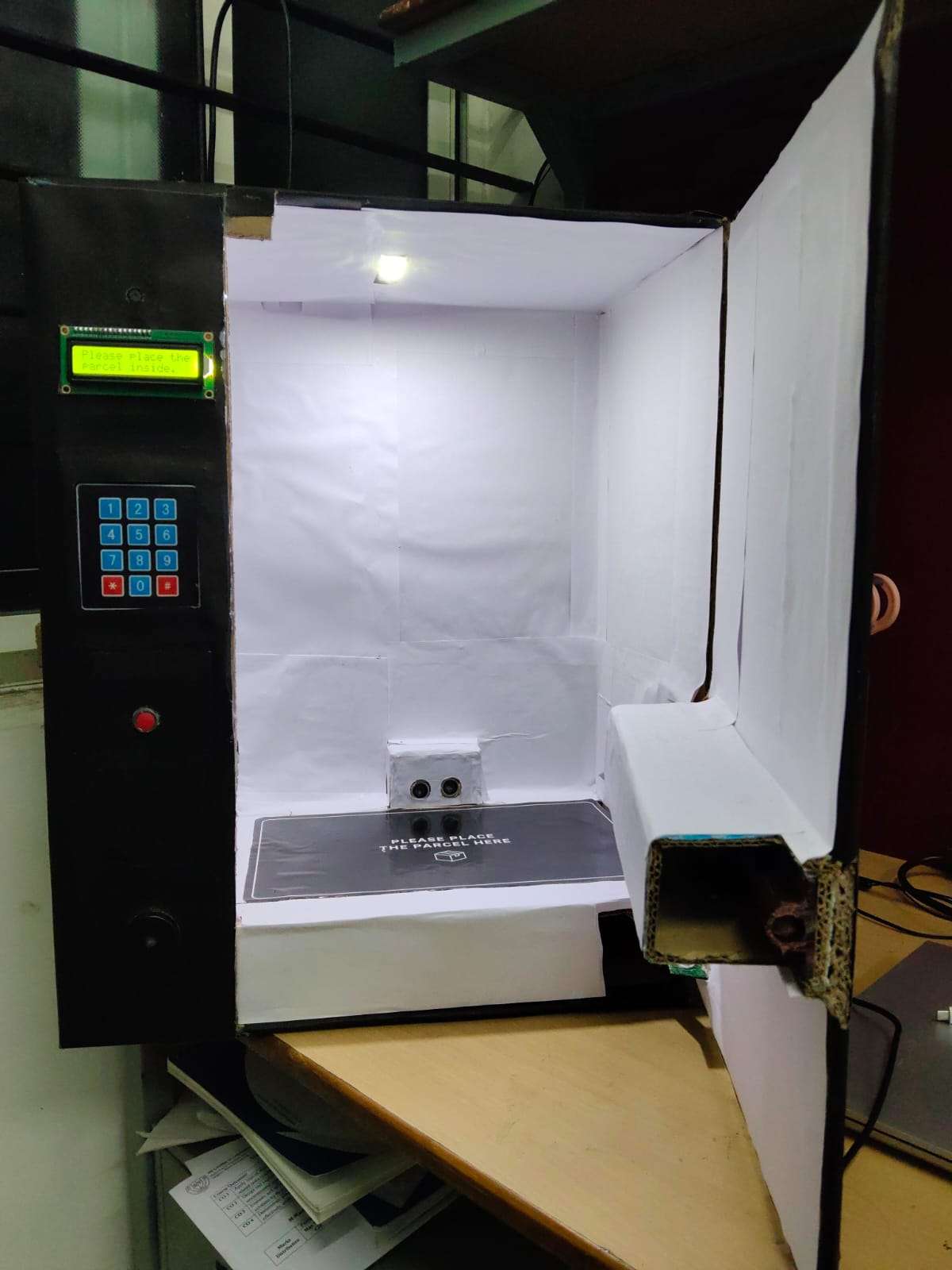
Final prototype of the SmartDrop
Challenges Faced During Project Development
- Hardware Integration Challenges
- Integrating multiple sensors, actuators, and communication modules with the ESP32 while ensuring reliable operation and proper power management was a significant challenge.
- Face Verification Accuracy
- Achieving consistent face verification under varying lighting conditions and camera angles required multiple rounds of testing and optimization.
- Real-Time Cloud Communication
- Establishing reliable communication between the ESP32, Firebase database, Node.js server, and mobile application while maintaining real-time synchronization was challenging.
- Servo Motor Mechanism Design
- Designing a stable and reliable door opening, closing, locking, and unlocking mechanism using MG996R and SG90 servo motors required several mechanical adjustments and testing iterations.
- Sensor Calibration
- Fine-tuning the ultrasonic sensor for accurate parcel detection and configuring the MPU6050 vibration sensor to distinguish actual tampering from normal environmental vibrations required careful calibration.
- GPS Signal Reliability
- Obtaining stable GPS coordinates, especially when the module was placed inside the enclosure, posed challenges during testing and implementation.
- System Integration
- Combining authentication, payment processing, parcel detection, image upload, GPS tracking, cloud communication, and security monitoring into a single coordinated workflow required extensive debugging and validation.
- Space Management Inside the Prototype
- Arranging all electronic components, wiring, sensors, and actuators inside the delivery box while maintaining adequate parcel storage space was a design challenge.
- Power Distribution and Stability
- Ensuring stable power delivery to high-current components such as servo motors without affecting the performance of the ESP32 and sensors required careful power management.
- Testing and Troubleshooting
Identifying and resolving software bugs, communication delays, sensor inconsistencies, and synchronization issues between hardware and cloud services was one of the most time-consuming aspects of the project
The SmartDrop project successfully demonstrates:
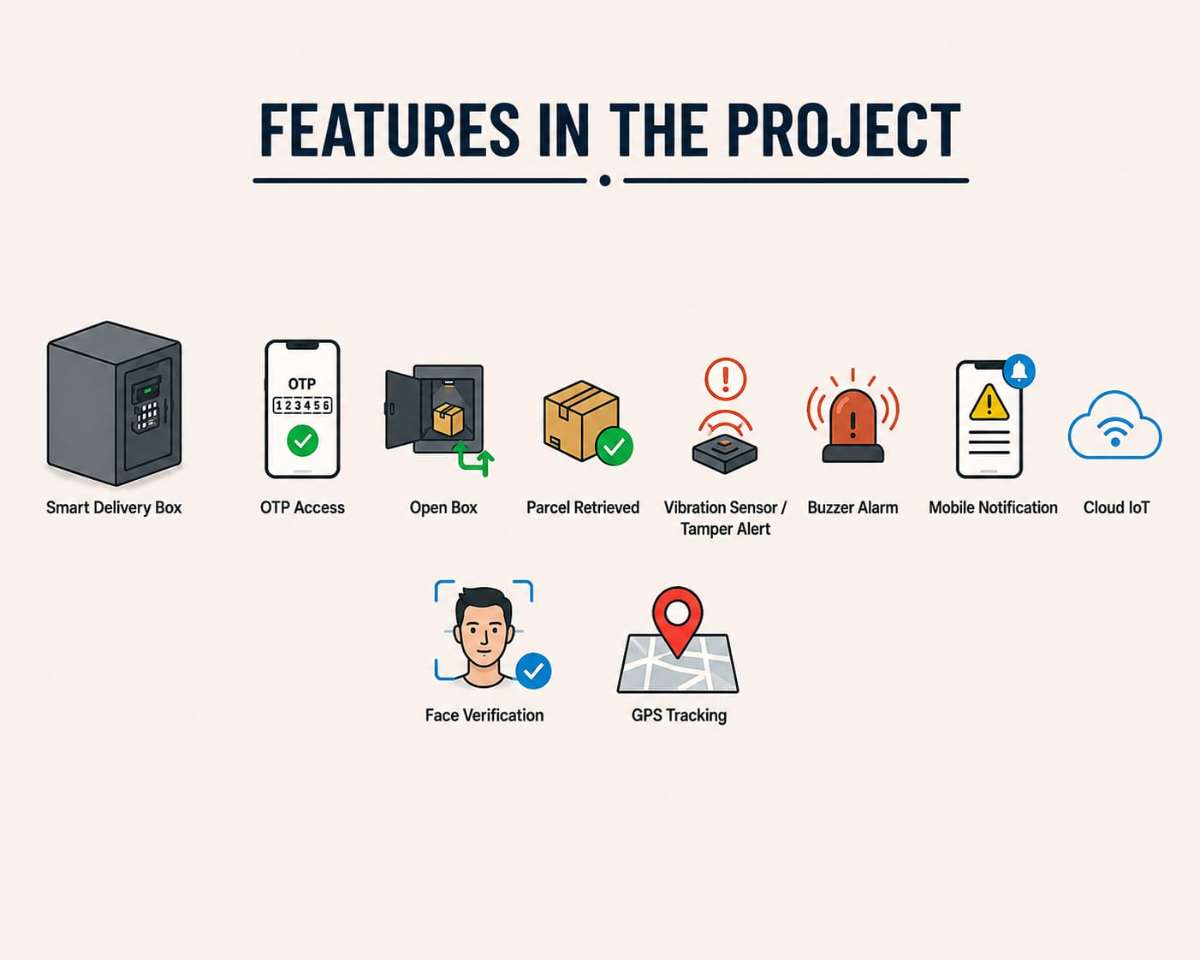
- Secure parcel delivery through face verification and OTP-based authentication.
- Automated door opening, closing, locking, and unlocking using servo motors.
- Reliable parcel detection using an ultrasonic sensor.
- Image-based delivery confirmation by capturing and uploading parcel images to the cloud.
- Real-time parcel status updates through Firebase cloud integration.
- Vibration-based tamper detection for identifying unauthorized access attempts.
- Automatic image capture and user alerts during tampering events.
- GPS-based location tracking of the SmartDrop box.
- Geofencing and alert generation for unauthorized relocation or theft detection.
- Real-time communication between hardware, cloud services, and mobile applications.
- Secure payment processing and delivery confirmation workflow.
- Convenient parcel retrieval through the user application.
- Integration of IoT, cloud computing, embedded systems, and mobile applications into a unified platform.
- Enhanced parcel security, delivery transparency, and user convenience through intelligent automation and monitoring.
Future Developments
Although the SmartDrop prototype successfully demonstrates secure and automated parcel delivery, several enhancements can be incorporated in future versions to improve functionality, scalability, and user experience.
- Integration of advanced AI models for more accurate and faster face verification under different lighting and environmental conditions.
- Implementation of biometric authentication methods such as fingerprint recognition for additional security.
- Addition of multiple parcel compartments to support the delivery and storage of multiple packages simultaneously.
- Integration of solar power systems to enable energy-efficient and self-sustaining operation.
- Development of a dedicated mobile application with enhanced user interfaces and advanced notification features.
- Implementation of real-time video streaming for live monitoring of delivery and retrieval activities.
- Integration of weight sensors to verify parcel placement and monitor parcel removal.
- Support for multiple delivery service providers through a centralized delivery management platform.
- Addition of backup communication technologies such as GSM/4G/5G for operation during Wi-Fi outages.
- Development of a commercial-grade prototype with improved mechanical design, weather resistance, and larger storage capacity.
These future enhancements can transform SmartDrop from a prototype into a scalable and intelligent smart parcel management solution suitable for real-world deployment.
Conclusion
The SmartDrop project successfully demonstrates the development of an IoT-driven secure parcel delivery and monitoring system that addresses key challenges in conventional parcel delivery services. By integrating face verification, OTP authentication, automated door control, parcel detection, image-based delivery confirmation, vibration-based tamper detection, GPS tracking, cloud connectivity, and mobile application support, the system provides a secure and reliable solution for parcel management.
The developed prototype enables delivery personnel to securely deposit parcels even in the absence of the recipient while ensuring that only authorized users can access the stored package. Real-time monitoring, tamper alerts, location tracking, and delivery verification further enhance the security and transparency of the delivery process.
The project also provided valuable hands-on experience in Embedded Systems, IoT, Cloud Computing, Computer Vision, Mobile Application Development, and System Integration. Through the successful integration of hardware and software technologies, SmartDrop demonstrates the potential of intelligent automation in improving the efficiency, security, and convenience of modern parcel delivery systems.


