




Overview
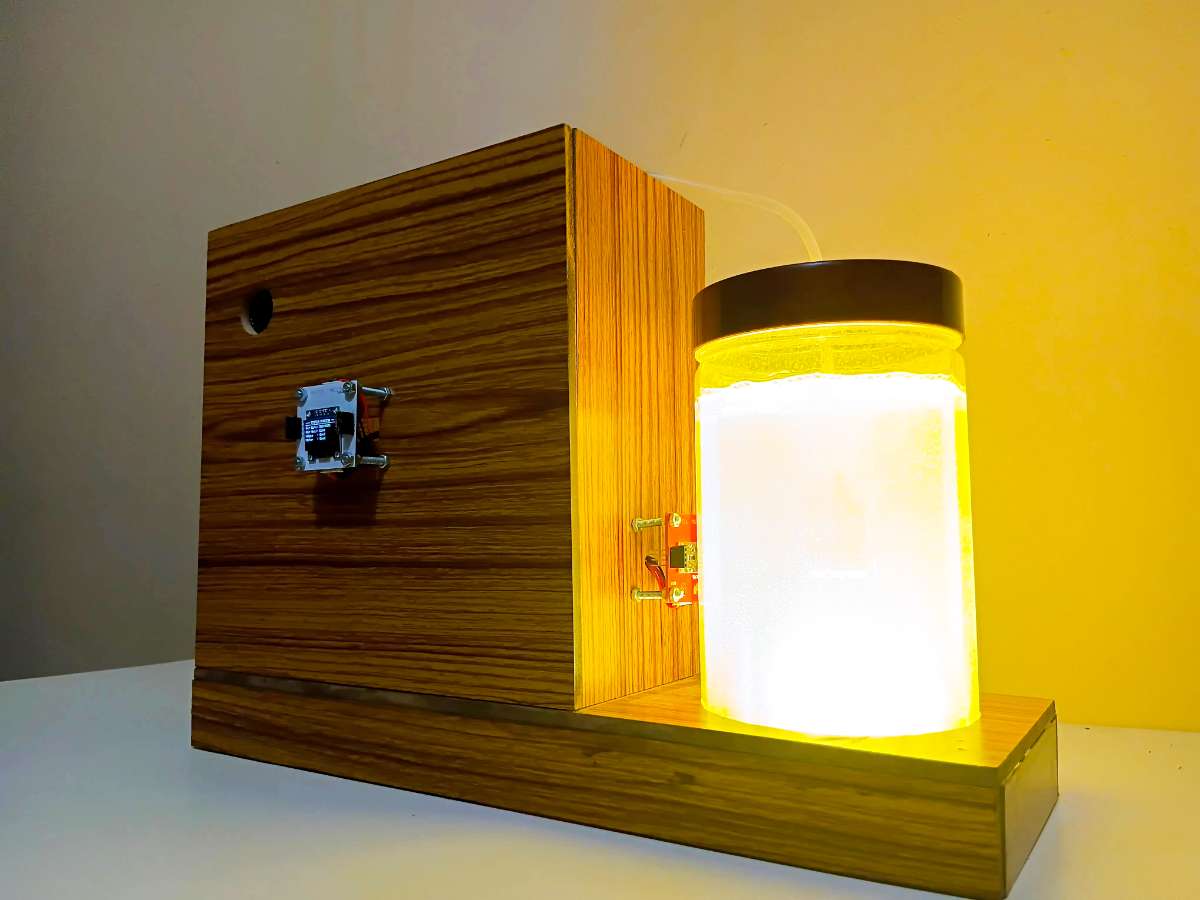
SmartBio Air is an experimental indoor environmental platform that combines biological air purification, embedded sensing, Edge AI automation, and cloud-assisted environmental observation into a single, reusable system.
The project has two complementary goals:
- Build a functional algae-assisted indoor air purifier that operates autonomously, even without an internet connection.
- Establish a reusable research platform capable of continuously studying the relationship between environmental conditions, pollution levels, and algae growth behaviour over time.
Rather than relying solely on mechanical filtration — which consumes power and requires constant filter replacement — SmartBio Air introduces a living microalgae chamber that naturally absorbs CO₂ and releases oxygen, while a network of sensors, an Edge AI controller, and a cloud analytics layer continuously observe and respond to changing indoor conditions.
Why This Project?
Indoor air quality is a growing health concern in homes, offices, and laboratories, yet most existing solutions fall short:
- Traditional purifiers only filter particulates, consume significant power, require recurring filter replacement, and provide no insight into why air quality changes over time.
- Algae-based purification is a promising natural alternative — algae absorb CO₂ and release oxygen — but existing implementations are typically confined to controlled laboratory experiments with no continuous monitoring, no autonomous control, and heavy dependence on cloud connectivity.
SmartBio Air was designed to close this gap: a system that brings biological purification out of the lab and into a real indoor environment, wrapped in embedded intelligence that keeps it safe, responsive, and self-sufficient — while still feeding a research pipeline for long-term analysis.
Problem Statement
Existing algae-based purification systems are limited by:
- No continuous environmental monitoring
- No autonomous, real-time control
- Heavy dependence on constant cloud connectivity
- No safety monitoring for mechanical components (pumps, motors)
- Limited real-world, long-duration usability
What's needed is a system that can operate safely indoors, continue functioning without internet access, continuously monitor environmental conditions, and support long-term data collection for research.
Project Objectives
| Goal | Description |
|---|---|
| Biological purification | Build an algae-based indoor air purifier |
| Environmental monitoring | Continuously track AQI, gas levels, temperature, and humidity |
| Autonomous operation | Use Edge AI for offline, real-time control |
| Hardware protection | Detect motor/pump faults using TinyML |
| Biological research | Study algae behaviour under varying pollution and light conditions |
| Long-term observation | Collect and visualize data for trend analysis over time |
System Architecture
SmartBio Air is built around two coordinated operational layers, intentionally separated so that all safety-critical operations continue even when the internet is unavailable.
1. Edge Control Layer (runs on the MYOSA Mini / ESP32)
- Real-time air quality monitoring
- Autonomous airflow and pump control based on pollution thresholds
- TinyML-based motor pump fault detection
- Local OLED status display
- Fully functional offline
2. Cloud AI Layer (active when internet is available)
- Uploads structured environmental logs to Azure
- AI-assisted environmental interpretation via Azure OpenAI
- Long-term trend and pattern analysis
- Web dashboard visualization (HTML/CSS/JS) hosted on Github page
.png)
Project Workflow
SmartBio Air was developed through nine engineering phases, moving from problem definition through hardware design, firmware development, TinyML integration, and finally experimental validation.
Phase 1 — Problem Identification & Planning
The project began with a study of indoor air pollution and the limitations of both mechanical filtration and lab-bound algae systems. The architecture was deliberately split into an Edge Control Layer (autonomous offline execution) and a Cloud AI Layer (long-term observation and analysis), ensuring safety-critical operations never depend on internet availability.
Phase 2 — Hardware Selection & System Architecture
Hardware was selected for low-power operation, embedded compatibility, modular expansion, and IoT communication support. The MYOSA Mini (ESP32-based) IoT Kit was chosen as the central controller for its wireless communication, embedded processing, and TinyML deployment capabilities.
| Component | Function |
|---|---|
| MYOSA Mini IoT Kit (ESP32) | Main embedded controller |
| MQ135 | Air quality sensing |
| MQ2 / MQ7 / MQ3 | Smoke, carbon monoxide & alcohol gas sensing |
| BMP180 / DHT22 | Temperature, humidity & pressure monitoring |
| APDS9960 | Ambient light sensing |
| MPU6050 | Pump vibration monitoring |
| SSD1306 OLED | Local system visualization |
| 6V DC Air Pump | Air circulation |
| Mini Fan | Airflow management |
| Relay Module / L298N Driver | Actuator & motor control |
| LED Grow Light | Photosynthesis support |
| Algae Chamber | Biological purification section |
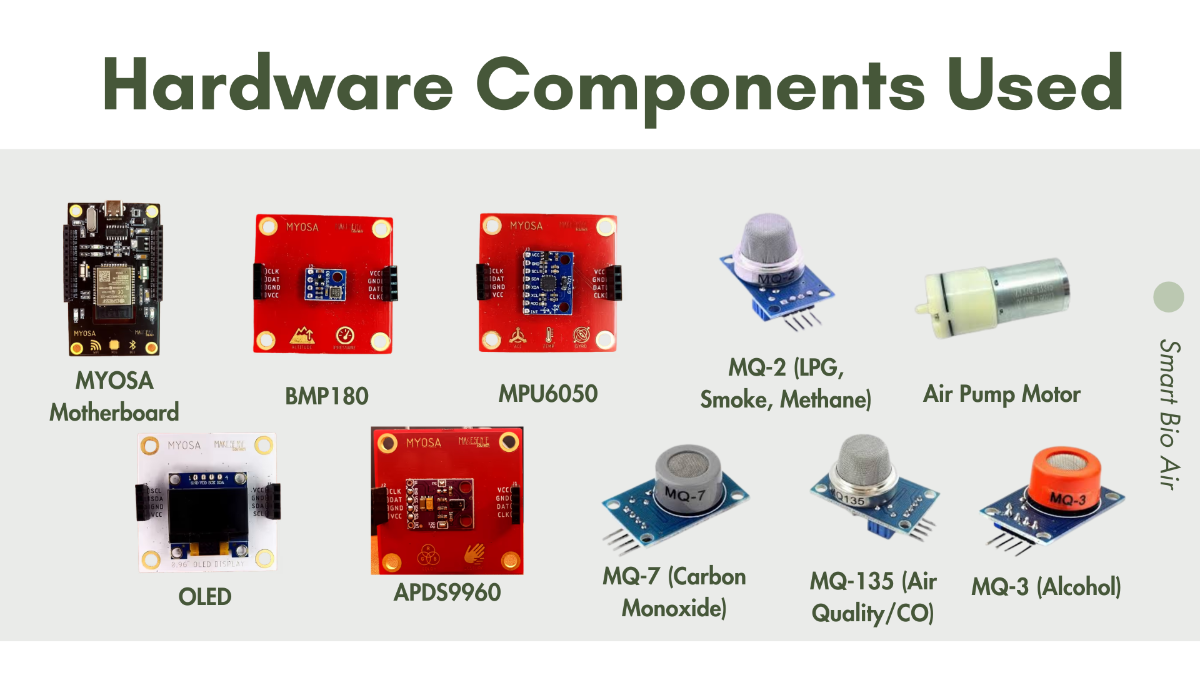
The architecture was designed modularly so additional sensors, AI models, or environmental modules can be integrated later without redesigning the entire system.
Phase 3 — Designing the Biological Algae Chamber

A transparent chamber was built to support continuous airflow interaction, light exposure, water circulation, and visual observation of the algae. Plant grow LEDs maintain photosynthetic activity during low-light indoor conditions, and air circulation pathways were arranged so indoor air continuously interacts with the biologically active chamber while sensors track environmental changes in real time.
Key design considerations included stable algae circulation, continuous oxygen exchange, controlled airflow, visual accessibility for observation, and low-power operation. Several chamber configurations were tested before finalizing the airflow arrangement and pump placement.
.gif)
Phase 4 — Sensor Integration & Circuit Assembly
Environmental sensing modules were interfaced with the MYOSA Mini controller to continuously monitor air quality, gas concentration trends, temperature, humidity, and pump vibration behaviour. Particular attention was paid to power stability and organized wiring to minimize sensor noise. Each sensor was individually calibrated and tested before full system integration, and the OLED display was wired in to allow local monitoring without cloud connectivity.
Parameters continuously monitored: Air Quality Index (AQI), VOC trends, temperature, humidity, and pump vibration behaviour.
Phase 5 — Embedded Firmware Development
Firmware was developed on the Arduino framework and structured into distinct functional layers for easier debugging and future expansion:
- Sensor acquisition layer
- Environmental analysis layer
- Edge control logic
- Display interface
- Cloud communication layer
The firmware continuously acquires sensor data, evaluates environmental conditions, controls airflow components, updates the OLED display, and transmits data to cloud services whenever connectivity is available. The purifier automatically activates when pollution levels exceed predefined thresholds.
Repository Modules
- AI Agent - Microsoft Azure
https://github.com/PlatoonX/SmartBio-Air/tree/main/agent_main - MYOSA Firmware
https://github.com/PlatoonX/SmartBio-Air/tree/main/myosa-main - Web Dashboard
https://github.com/PlatoonX/SmartBio-Air/tree/main/webapp_main
Phase 6 — TinyML-Based Motor Pump Fault Detection
To improve long-term reliability, an MPU6050 vibration sensor was mounted near the air pump and used to train a lightweight classification model in Edge Impulse, distinguishing normal operation from fault conditions.
| Class | Samples |
|---|---|
| Normal | 4,000 |
| Fault | 4,000 |
| Metric | Value |
|---|---|
| Training Accuracy | 98.1% |
| Test Accuracy | 97.23% |
| Inference Time | 1 ms |
| RAM Usage | 3 KB |
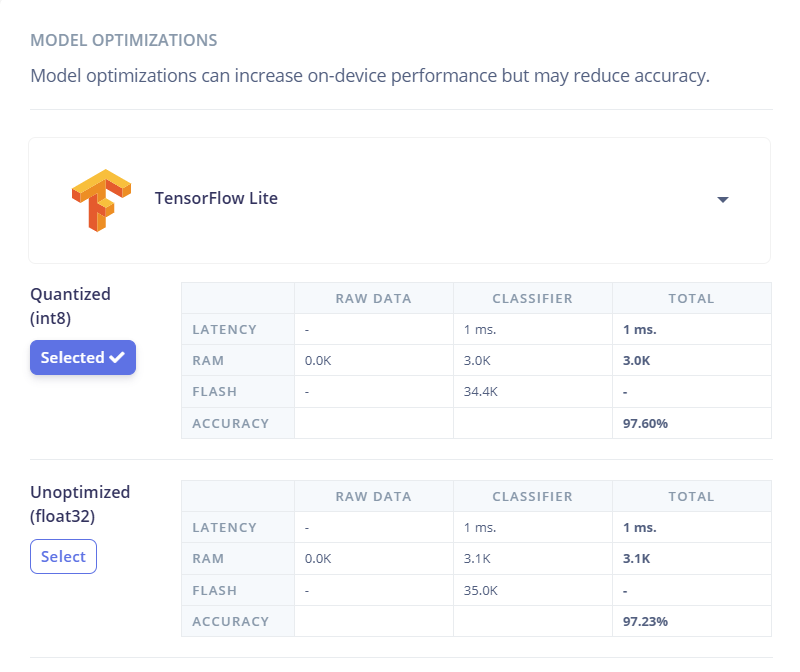
The final TensorFlow Lite model runs directly on the MYOSA Mini for offline, real-time inference, allowing the system to detect unstable vibration, pump blockage, abnormal operating behaviour, and dry-running conditions — and to stop the motor automatically to prevent damage.
Phase 7 — Cloud AI Layer & Web Dashboard
While safety-critical decisions remain local, environmental measurements are also transmitted to cloud services for research observation and historical analysis. Cloud services handle structured environmental logging, dashboard visualization, AI-assisted environmental interpretation, and long-term trend observation.
A lightweight web dashboard (HTML/CSS/JS) visualizes environmental conditions, pollution trends, algae chamber behaviour, and operational status — acting as the observation layer of the research platform.
.gif)
Phase 8 — Final Prototype Integration
All subsystems — the algae purification chamber, environmental sensing modules, Edge AI controller, motor control system, OLED display, and cloud communication interface — were assembled into the final prototype. Cable management and hardware placement were optimized for airflow stability and overall organization, and the prototype was tested continuously under indoor conditions to evaluate long-duration operational stability.
.png)
Phase 9 — Experimental Indoor Testing
Note: This testing was conducted at prototype level in a real indoor environment, not in a controlled laboratory setting.
| Parameter | Value |
|---|---|
| Location | Coimbatore |
| Environment Type | Semi-urban |
| Room Size | 250 sq ft |
| Ventilation | Closed room |
| Test Duration | 2 hours |
| Number of Trials | 5 (Days) |
Results
| Trial | Initial AQI | Final AQI | AQI Reduction | Initial CO₂ (ppm) | Final CO₂ (ppm) | CO₂ Reduction |
|---|---|---|---|---|---|---|
| 1 | 162 | 118 | 27.1% | 1180 | 860 | 27.1% |
| 2 | 176 | 121 | 31.2% | 1280 | 870 | 32.0% |
| 3 | 158 | 109 | 31.0% | 1150 | 790 | 31.3% |
| 4 | 171 | 122 | 28.6% | 1240 | 890 | 28.2% |
| 5 | 168 | 116 | 31.0% | 1210 | 845 | 30.1% |
Across five trials, SmartBio Air achieved an average pollution reduction of roughly 30% in both AQI and CO₂ levels within a two-hour window. The Edge-based architecture maintained stable operation throughout, including during temporary network interruptions, while continuous environmental logging enabled structured observation of both air quality and biological chamber activity across repeated cycles.
DEMO Video
Presentation Video
This presentation explains the project architecture, objectives, workflow, TinyML integration, cloud AI layer, and experimental results.
Main Features
- Algae-assisted air purification
- Multi-gas environmental sensing
- TinyML motor fault detection
- Autonomous offline operation
- Cloud AI environmental analysis
- OLED status display
- Web dashboard monitoring
- Real-time sensor monitoring
- Edge AI safety execution
- Research-oriented, modular architecture
Tech Stack
Hardware
| Component | Role |
|---|---|
| MYOSA Motherboard (ESP32) | Main controller |
| MQ-2 / MQ-3 / MQ-7 / MQ-135 | Gas & air quality sensing |
| BMP180 | Temperature & pressure |
| APDS9960 | Light sensing |
| MPU6050 | Vibration / fault sensing |
| SSD1306 OLED | Status display |
| L298N Motor Driver / Relay Board | Actuator control |
| DC Air Pump & Mini Fan | Air circulation |
| Plant Grow LED | Algae photosynthesis support |
Software & Cloud
| Technology | Usage |
|---|---|
| Arduino IDE | Firmware development |
| Edge Impulse | TinyML model training & inference |
| Azure Functions | Cloud backend |
| Azure OpenAI | AI-driven environmental analysis |
| HTML / CSS / JS | Web dashboard |
Project Outcomes
- Functional algae-based indoor air purifier
- Continuous environmental monitoring
- Autonomous Edge AI execution
- Pollution and algae growth dataset
- TinyML research platform
- IoT-based environmental monitoring system
- Cloud-connected research workflow
Installation
Clone the Repository
git clone https://github.com/PlatoonX/SmartBio-Air.gitRun the Web Dashboard
Open index.html in a web browser.Requirements to Reproduce or Extend This Project
- Hardware (minimum): Wi-Fi capable microcontroller (MYOSA Mini / ESP32), low-voltage DC air pump and fan, transparent algae chamber or container, gas/temperature/humidity sensors, an IMU (MPU6050 or equivalent), a small OLED or status display, relays or MOSFETs for actuator control, and a reliable power supply.
- Software & accounts: Arduino IDE (or PlatformIO); an Edge Impulse account for TinyML dataset/model work (optional but recommended); an optional cloud account (Azure or equivalent) for long-term logging and dashboard hosting.
- Data & models: Example datasets and an exported TFLite model are provided in
tinyml_motorpumpfaultdetection/. Plan to collect labeled vibration samples if retraining models. - Tools & accessories: Soldering iron, wire strippers, multimeter, jumper wires, pump tubing, mounting hardware, and silicone sealant or gaskets for leak prevention.
- Skills & knowledge: Basic Arduino/C++ firmware skills, familiarity with Edge Impulse or TinyML workflows, basic HTML/CSS/JS for the dashboard, and basic data-analysis skills (Python/Jupyter recommended).
- Safety & lab considerations: Handle algae cultures responsibly (avoid uncontrolled release), keep electrical components away from water, use drip trays, use GFCI-protected power sources, and follow local biosafety guidance.
- Optional extras: Camera for time-lapse imaging, additional sensors (CO₂ NDIR, particulate matter), and an enclosure for a production-ready prototype.
Project Structure
SmartBio-Air/\n│\n├── data/\n│ ├── datacollectionscript/\n│ └── datasets/\n│\n├── tinyml_motorpumpfaultdetection/\n│ ├── faultdetection_inferencing/\n│ └── faultdetection_modelfile/\n│\n├── myosa-main/\n├── agent_main/\n├── webapp_main/\n│\n└── src/\n ├── img/\n └── gif/Project Link 🔗
https://github.com/PlatoonX/SmartBio-Air
Future Scope
- Mobile application integration
- Advanced AI prediction models for pollution forecasting
- Real-time alert and notification system
- Smart home / IoT ecosystem integration
- Larger-scale, multi-chamber algae installations
- Industrial environmental monitoring deployments
Contributors
| Nimalan Parameswaran — @nimalan-parameswaran |
| Dhakshatha M K — @DhakshathaMylsamy |
Acknowledgement
We express our sincere gratitude to Dr. Dinesh Chellappan, Centre for Research and Development, for his valuable guidance, technical direction, and continuous mentorship throughout this project.
We also extend our heartfelt thanks to the IEEE Sensors Council for sponsoring the MYOSA Mini IoT Kit, which played a crucial role in enabling the development and implementation of this work.
License
This project is licensed under the MIT License.
MIT License\n\nCopyright (c) 2026 PlatoonX\n\nPermission is hereby granted, free of charge, to any person obtaining a copy\nof this software and associated documentation files (the "Software"), to deal\nin the Software without restriction, including without limitation the rights\nto use, copy, modify, merge, publish, distribute, sublicense, and/or sell\ncopies of the Software, and to permit persons to whom the Software is\nfurnished to do so, subject to the following conditions:\n\nThe above copyright notice and this permission notice shall be included in all\ncopies or substantial portions of the Software.\n\nTHE SOFTWARE IS PROVIDED "AS IS", WITHOUT WARRANTY OF ANY KIND, EXPRESS OR\nIMPLIED, INCLUDING BUT NOT LIMITED TO THE WARRANTIES OF MERCHANTABILITY,\nFITNESS FOR A PARTICULAR PURPOSE AND NONINFRINGEMENT. IN NO EVENT SHALL THE\nAUTHORS OR COPYRIGHT HOLDERS BE LIABLE FOR ANY CLAIM, DAMAGES OR OTHER\nLIABILITY, WHETHER IN AN ACTION OF CONTRACT, TORT OR OTHERWISE, ARISING FROM,\nOUT OF OR IN CONNECTION WITH THE SOFTWARE OR THE USE OR OTHER DEALINGS IN THE\nSOFTWARE.


