




Description:
DysphagiaGuard is a wearable, Edge AI-powered healthcare system developed to assist individuals suffering from dysphagia (swallowing disorders). The device is worn around the neck and continuously monitors swallowing activity by combining throat motion data from an MPU6050 IMU with swallowing acoustic signals captured using a MAX9814 microphone. These signals are processed locally on an ESP32 using lightweight TinyML-based classification to identify abnormal swallowing patterns in real time.
Whenever a potentially unsafe swallowing event is detected, DysphagiaGuard immediately notifies caregivers through a buzzer, vibration motor, RGB LED, and an offline Android application. All swallowing events are securely stored locally and can be reviewed later for monitoring and analysis. Since the entire system operates without cloud connectivity, it provides low-latency performance, protects patient privacy, and remains reliable even in areas without internet access.
Designed to be affordable, portable, and easy to use, DysphagiaGuard aims to support continuous home-based monitoring for elderly individuals and patients recovering from stroke or living with neurological disorders such as Parkinson's disease and ALS. By enabling early detection of abnormal swallowing patterns and timely caregiver intervention, the system contributes to safer and more accessible long-term dysphagia care.
Step 1: Problem Identification
Dysphagia (swallowing disorder) affects millions of elderly and neurological patients. Since unsafe swallowing often occurs outside hospitals, caregivers have no continuous way to monitor patients at home. Existing solutions are expensive, hospital-based, or require continuous clinical supervision.
Our goal was to develop a low-cost, wearable, Edge AI device capable of monitoring swallowing activity in real time while operating completely offline.
Step 2: System Design
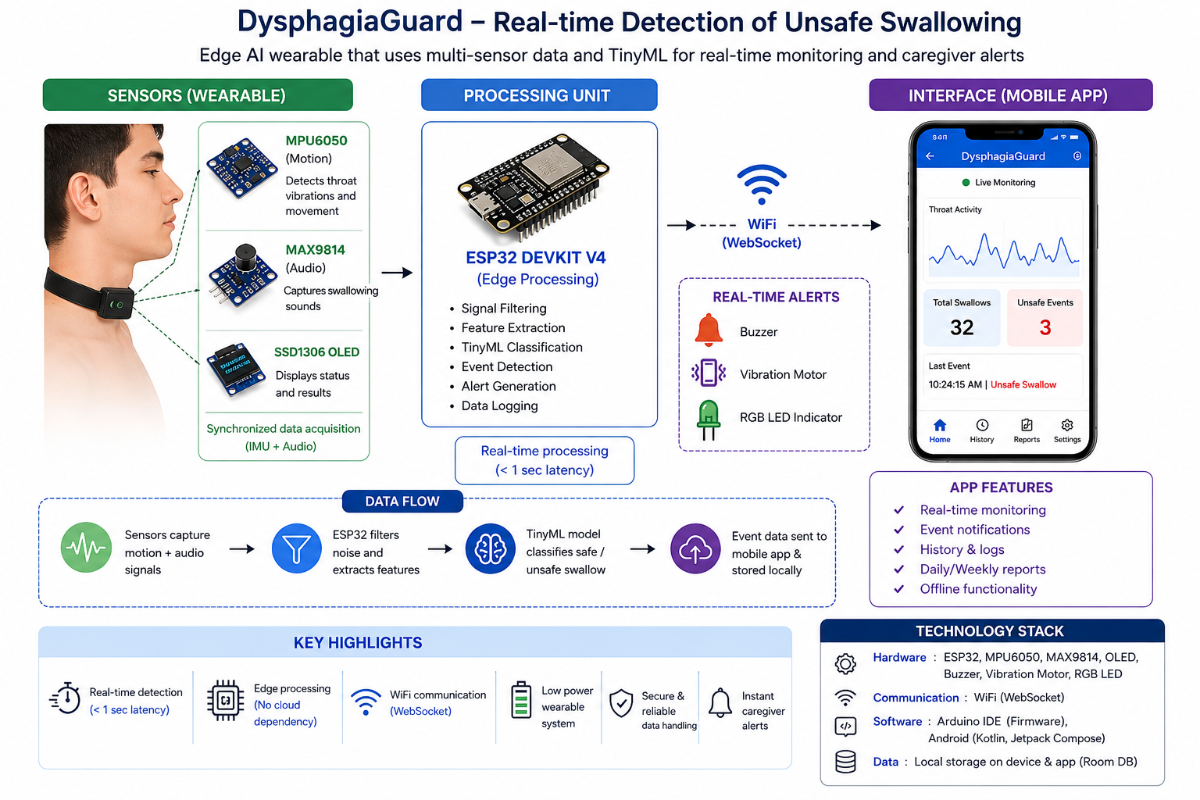
We designed a wearable architecture that combines motion sensing and acoustic sensing to capture swallowing activity.
Hardware Components
- ESP32 DevKit V4
- MPU6050 IMU
- MAX9814 Microphone
- SSD1306 OLED Display
- RGB LED
- Piezo Buzzer
- Vibration Motor
- LiPo Battery
- TP4056 Charging Module
The ESP32 acts as the central controller, collecting sensor data, processing it using TinyML, and communicating with the Android application.
Step 3: Sensor Integration
The MPU6050 was mounted near the throat to capture laryngeal movement during swallowing.
The MAX9814 microphone was positioned to record swallowing sounds while minimizing ambient noise.
Both sensors continuously stream data to the ESP32.
Step 4: Signal Processing
Raw sensor signals contain noise caused by speech, body movement, and environmental sounds.
To improve signal quality, we implemented:
- Moving Average Filtering
- Noise Reduction
- Signal Normalization
- Sliding Window Segmentation
These preprocessing steps ensure stable and reliable swallowing data.
Step 5: Feature Extraction
From the processed sensor signals, meaningful features were extracted.
IMU Features
- Peak acceleration
- Angular velocity
- Motion duration
- Signal energy
Microphone Features
- Signal energy
- Peak amplitude
- Frequency characteristics
- Temporal patterns
These features represent each swallowing event and are passed to the classifier.
Step 6: TinyML-Based Swallow Classification
A lightweight TinyML model running on the ESP32 analyzes the extracted features.
The classifier distinguishes between:
- Normal swallowing
- Abnormal swallowing patterns
- Non-swallow activities such as speaking or coughing
By combining both motion and acoustic information, the system achieves more reliable detection than using a single sensor.
.jpeg)
Step 7: Real-Time Alerts
Whenever an abnormal swallowing event is detected, the ESP32 immediately activates:
- Piezo buzzer
- RGB LED
- Vibration motor
These alerts notify nearby caregivers without requiring internet connectivity.
.jpeg)
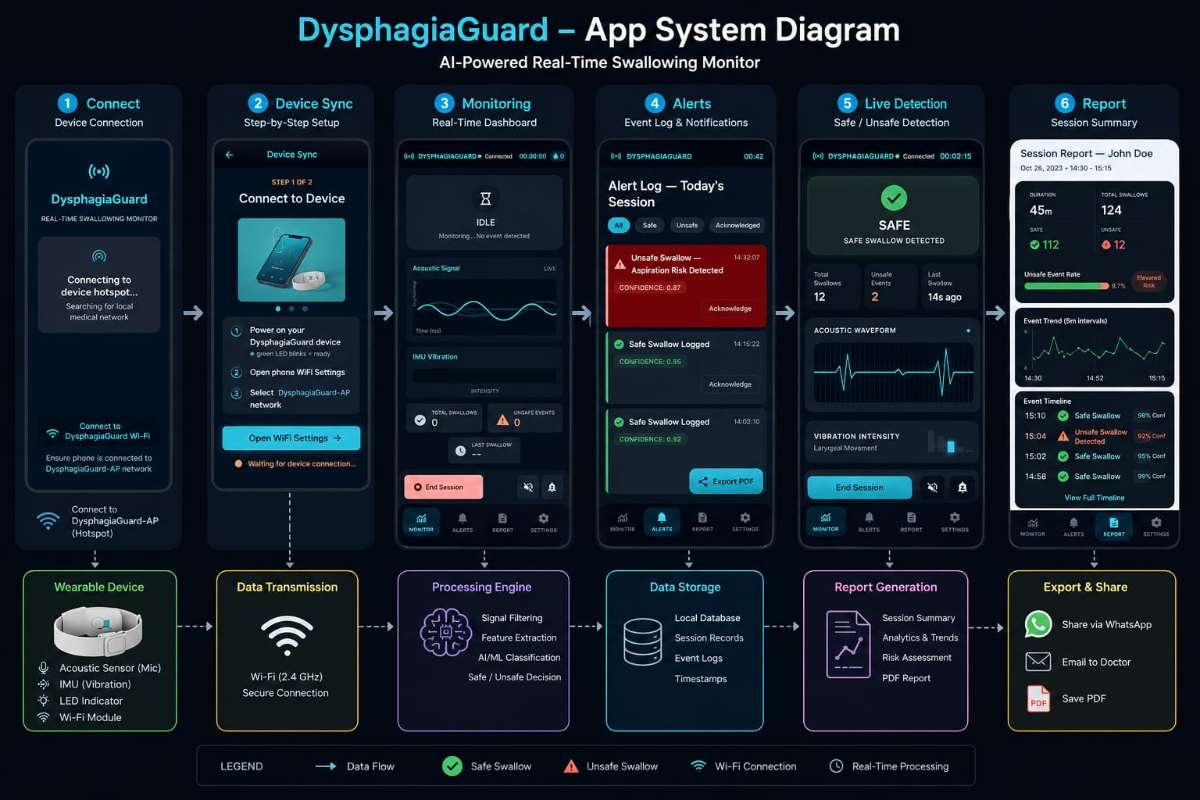
Step 8: Android Application
A dedicated Android application was developed using:
- Kotlin
- Jetpack Compose
- Room Database
- MVVM Architecture
- WebSocket Communication
The application displays:
- Live swallowing status
- Event history
- Timestamps
- Device connection status
- Offline reports
Step 9: Offline Communication
Instead of cloud services, the ESP32 hosts a local WebSocket server.
Advantages include:
- Low latency
- Better privacy
- No internet dependency
- Reliable operation in hospitals and homes
Step 10: Testing and Optimization
Multiple swallowing sessions were performed to evaluate system performance.
Several improvements were implemented:
- Optimized sensor placement
- Reduced microphone noise
- Improved TinyML inference speed
- Lowered power consumption
- Enhanced alert responsiveness
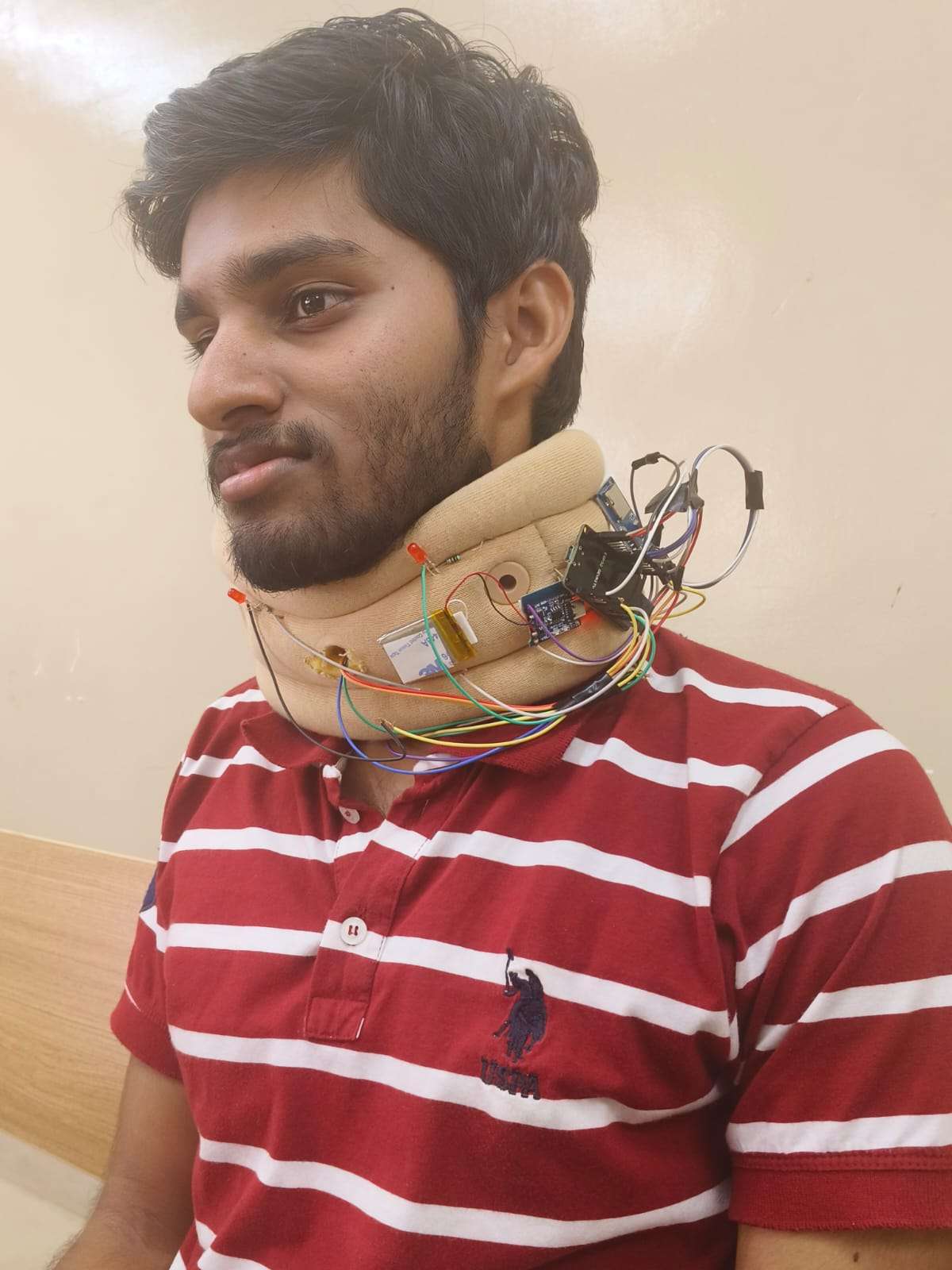
The final prototype successfully performs continuous swallowing monitoring with real-time caregiver alerts.
.jpeg)


