



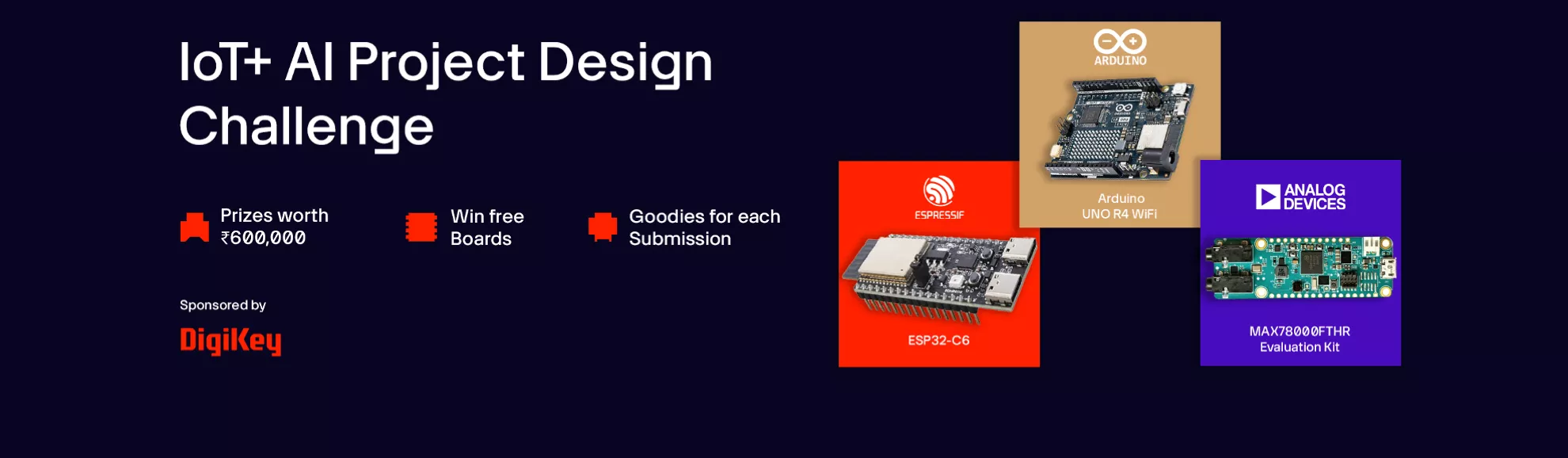
Overview
With the power of AI at the edge, IoT devices are becoming faster, more efficient, and capable of making real-time decisions.
AI combined with IoT is shaping the future of embedded systems, enabling smarter homes, safer and more efficient industries, and more responsive healthcare.
If you’re passionate about building with hardware and exploring the possibilities of IoT and AI, this challenge is for you!
Build something meaningful—whether it’s a smart home solution, health tracker, or industrial application.
The challenge is open for all developers, Makers & students from India.
Hardware Boards
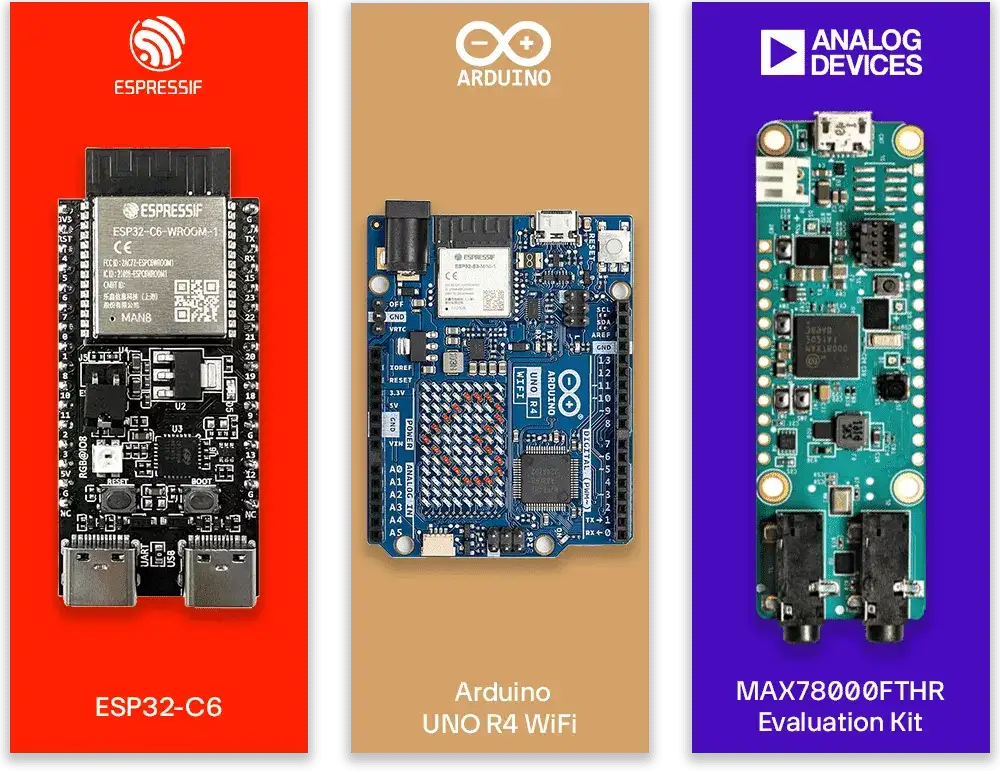
To help you bring your idea to life, Contest sponsor DigiKey is providing free development boards.
Simply choose one of the boards listed below and submit your project idea.
We will review all submissions and select the top 50 ideas. Once your idea is selected, you can order the board directly from DigiKey, and we’ll cover the full cost of the development board
 |
Prizes
Judges will select the winners based on criteria (Ref. Rules).
 |  |  |
Creative Project Prize
 | The top 5 projects will get a prize of ₹10,000 each. |
Goodies
 | All project submissions will receive exciting goodies. |
How to Participate in this Contest?
 | Step 1: Register To start, sign in/ Sign up to ElectronicWings.com and simply click to Participate in the contest. |
 | Step 2: Apply for Hardware Once registered, submit your project ideas to “Apply for hardware”. Simply choose one of the boards and submit your project idea. |
 | Step 3: Get Your Development Boards from DigiKey Upon selection of your idea, proceed to purchase your development board from DigiKey. Learn more about a hassle-free checkout experience. We’ll cover board costs by providing a rebate upon successful submission of your project. |
 | Step 4: Build Your Project Start building your project using the development board. You can also use any extra components you have to bring your idea to life and create a great demo. |
 | Step 5: Make Video & Documentation Document your project with all details—circuit diagrams, code, and images. Also, create a video showing your project in action(Use non-copyright content). Don’t forget to create a BOM using “DigiKey- myList”. You can check our sample project for reference. |
 | Step 6: Submit Your Project Once your documentation and video are ready, submit your project by clicking “+ Project”. Be sure to add the link to the BOM using DigiKey myList. Also, review the judging criteria to enhance your chances of winning. |
Note: If you don’t win a free board, you can still participate using your own board. Just make sure it’s one of the three listed boards and that you meet the submission criteria. All participants are equally eligible for goodies and prizes.
Boards
| 💡Arduino UNO R4 WiFi |
| 💡ESP32-C6-DEVKITC (Espressif Systems) |
| 💡ADI’s MAX78000FTHR |
Judges
 | Penny Tse Penny Tse is a senior manager, application engineering, APAC, at DigiKey. He has been with the company since 2013 and has significant experience in providing technical services to engineers for their design and application purposes. With more than 20 years of industry experience, Penny has worked with OEMs, ODMs, CMs, makers and universities to understand technology trends and market needs. He holds a bachelor’s degree in electronics engineering information and communication from Hong Kong University of Science and Technology (HKUST). |
 | Mahmad Bharmal Mahmad is a Senior Software Engineer at Google with over seven years of industry experience specializing in embedded systems, firmware development, and kernel programming. He began his career at Intel, contributing to the firmware for Intel’s Bluetooth solutions, and later worked on silicon validation software for Google’s Tensor SoCs. Currently, he is part of the team developing software for the Pixel Watch. Mahmad holds a Master’s degree in Embedded Systems Design and brings deep expertise in system software engineering. |
 | Piyush Itankar Piyush is an Embedded Software Engineer at Google, with a strong background in system-level firmware and embedded development. He began his career at Intel, where he contributed to navigation firmware, Bluetooth driver development, and RF validation software. At Google, he has led firmware development efforts for the Power Management Subsystem on Tensor SoCs powering Pixel phones, and is currently focused on system software for the Pixel Watch. Piyush holds a Master’s degree in Embedded Systems and a Bachelor’s in Electrical Engineering. |
 | Umesh Lokhande Umesh is the founder of BinaryUpdates and has over 15 years of experience in embedded hardware and software. He has previously worked with companies such as Orbotech and Alere Technologies GmbH. Umesh also enjoys creating engineering videos for the BinaryUpdates YouTube channel, which has over 42K subscribers. |
 | Aswin Babu Aswin Babu is an academic program engineer/application engineer at DigiKey. He specializes in embedded systems and robotics, bringing a strong technical foundation and expertise in IoT protocols, robotic navigation, route planning and mapping, and embedded software development. Beyond his engineering expertise, Aswin is passionate about public speaking, beekeeping and gardening. Aswin holds a postgraduate degree in robotics, computer vision and machine learning from the University of Surrey, and a bachelor’s degree in electrical engineering from the College of Engineering Trivandrum (CET). |
For any query, contact us
- WhatsApp- +91 915 6679 224
- Email- [email protected]